Landfill faces SMEC Scrutiny after Solid Waste Board letter delay
PROTECTED CONTENT
If you’re a current subscriber, log in below. If you would like to subscribe, please click the subscribe tab above.
Username and Password Help
Please enter your email and we will send you a password reset link.
Landfill faces SMEC Scrutiny after Solid Waste Board letter delay

Photos by Shane Gilreath
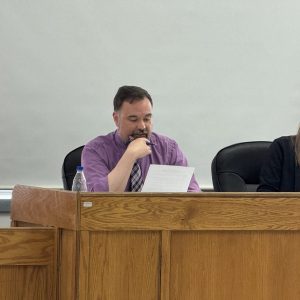
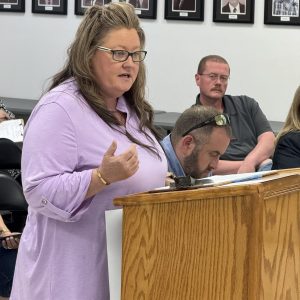
During a meeting of the Scott-McCreary Environmental Coalition, otherwise known as SMEC, members took questions from the community and addressed concerns over an August Scott Solid Waste Board letter, before going into Executive Session with their attorney, Lisa Helton.
By Shane Gilreath
SCN Contributing Editor
[email protected]
Two weeks ago, SCN reported a story on the Scott County Solid Waste Board (SCSWB) letter, adopted in August 2025, objecting to a second landfill in Scott County. That issue carried over to last week’s Scott-McCreary Environmental Coalition (SMEC) meeting at Oneida City Hal, when Winfield Mayor Jerry Dodson, who serves as Chair of the SCSWB, presented SCN and SMEC – made up of members of regional governments – with a copy of the adopted letter. Dodson wanted to assure members that the letter existed and had been adopted.
The existence of the letter, however, was never in question, but whether it had reached the Tennessee Department of Environment and Conservation (TDEC) in a timely fashion had been uncertain. Senior Communications Advisor Jennifer Donnals confirmed to SCN that TDEC did not receive the letter until February 3, 2026 – nearly six months after adoption. Submission came via Kathy Obrusanszki, a member of the executive committee of Cumberland Clear, a citizen group formed largely in opposition to the Roberta II landfill project.
Such letters carry significant weight in Tennessee’s permitting process. While TDEC ultimately issues or denies landfill permits, the department relies heavily on local waste boards to clarify community need. With formal objections on record, applicants such as Roberta II can face significant hurdles, making SCSWB’s stance a critical factor in the debate. Scott County Mayor Jerried Jeffers told SCN that the letter had been mailed – even if it had not reached TDEC – and assured readers that the letter was legally placed on record in Scott County. Under questioning from SCN, Donnals confirmed that TDEC deems the letter binding, regardless of the delivery timeline and how the department ultimately received it.
During the SMEC meeting, Oneida Mayor Lori Phillips-Jones, who chairs SMEC, also confirmed that TDEC was now in possession of the letter.
Cumberland Clear President Jennifer Shockley thanked SMEC members for advocating on behalf of the community. Regarding Roberta’s application for an Aquatic Resource Alteration Permit (ARAP) — which the SCSWB could influence – Shockley emphasized urgency: “Because of the ARAP permit, we don’t know when they’ll approve it. If you want to act, do that with some urgency.”
Shockley also noted the controversial nature of ARAPs, permits required before projects alter streams, wetlands, or other water resources. “Because the ARAP has such a major impact, (Roberta II) has to prove that the environmental degradation comes with a positive for the community,” she said. Environmental advocates, however, argue that ARAPs can be mirky, difficult to challenge, and may insufficiently account for long-term environmental and ecological harm, a concern long echoed by the EPA on water quality permits.
Roberta II has faced strong public backlash. “Businesses already have a hard time getting people to move here,” Shockley told the coalition. “And also the tourism community,” Obrusanszki added. “This will not be a net positive for our community.”
Obrusanszki said that while objections exist, those impacted must ultimately provide evidence and it was important for them to be vocal. Affected businesses and organizations could submit formal objections, joining others who have already spoken out.
In August 2025, the McCreary County Tourist Commission issued a formal statement of non-support against the Roberta II landfill, citing environmental degradation, economic harm to local businesses, and reputational risk to McCreary County tourism. The statement read, in part: “We support the McCreary County Fiscal Court in its consideration of the irreversible consequences this development could pose to our environment, economy, and community image. We remain committed to supporting initiatives that enhance, not diminish, McCreary County’s appeal as a tourism destination.”
The National Park Service has also expressed deep concerns over the looming project.
Environmental observers note that ARAP permits, while necessary for regulating water resource alterations, are controversial in communities nationwide. Critics argue that permit approvals can be inconsistently applied or inadequately account for actual environmental impacts. The EPA oversees state water quality certifications and recommends careful review to ensure projects do not degrade aquatic ecosystems, but local and state-level controversies persist. For communities like Scott and McCreary Counties, ARAP outcomes can decisively shape the environmental and economic future.