TDEC agrees with Transparent Bridge; Jackson Law never expired
PROTECTED CONTENT
If you’re a current subscriber, log in below. If you would like to subscribe, please click the subscribe tab above.
Username and Password Help
Please enter your email and we will send you a password reset link.
TDEC agrees with Transparent Bridge; Jackson Law never expired
By Shane Gilreath

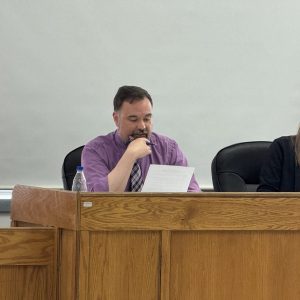
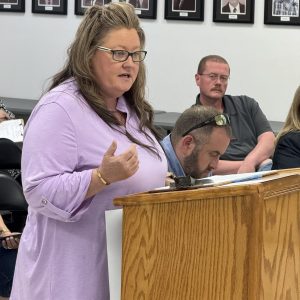
Cody Cox, pictured, of the Transparent Bridge Initiative, has often been the public face of the organizations at event’s involving the proposed landfill. He and co-founder Lisa Wojcik have been diligent in their research efforts and communications with TDEC.
Two weeks ago, as the Transparent Bridge Initiative’s Cody Cox approached the lectern to address the Scott County Solid Waste Board (SCSWB), he did so armed with one of thousands of documents that the organization – one of two formed to combat the proposed second landfill – had unearthed in their desperate plea to halt what many have deemed the environmental degradation of Scott and McCreary Counties. The issue, which Cox planned to address, had first sprang to life in May, when stories leaked on social media suggesting plans for Roberta Landfill Phase II, of whom Knox Horner, a Cleveland, TN-based businessman has been the face.
“I would hope the citizenship would withhold any judgment until they have all the information,” Horner told SCN at the time, saying that being added to the County Commission’s May 2025 agenda had taken him by surprise. Records show, however, that the plans of Horner and his cohorts had long meandered in that direction, having met with local officials and appeared before the SCSWB in March, pitching plans for what he has consistently called “a group of investors.”
Beginning with the May meeting and contrary to public sentiment, County Mayor Jerried Jeffers and County Attorney John Beaty have consistently maintained that the County Commission has no authority to act on the matter, stemming largely from a controversial 1992 Court ruling and an ordeal revolving around a 1989 state statute known as Jackson Law, which permits county and municipal governments the right to approve landfills within the parameters of their jurisdiction. Though the Scott County Commission initially opted into the law in July 1989, according to state records, that resolution was believed to have expired in 2010, leading the Scott County Commission to re-adopt Jackson Law in June, a vote which may have been an oversight in public records.
As Cox approached SCSWB on August 11, 2025, he carried with him the evidence which he and Transparent Bridge Co-founder Lisa Wojcik had unearthed during their research – a resolution amending Scott County’s Jackson Law in 2013, which had passed the SCSWB, the County Commission, and signed into law by then-County Mayor Jeff Tibbals. It was evidence, Cox urged, that Jackson Law had never expired, giving the County Commission some authority on the issue.
As it turns out, the Tennessee Department of Environment and Conservation (TDEC) may agree. TDEC’s Senior Communications Advisor Jennifer Donnals told SCN last week that, despite being unaware of the County’s 2013 amendment resolution, the department “never considered the adoption expired.” In spite of Donnals statement, Scott County was presumed expired via TDEC’s website until last week, when Cox and Wojcik presented the 2013 evidence to TDEC’s Nick Lytle, who, upon examining the evidence from Transparent Bridge, requested the website be updated to show Scott County in compliance with Jackson Law. That update was officially made on August 20, 2015, recognizing the 2013 County Commission vote.
“TDEC recently became aware that Scott County had readopted the Jackson Law in 2013,” Donnals said. “Additionally, we have learned that on June 3, 2025, the Scott County Commission once again voted to adopt the Jackson Law. The department’s website has been updated to reflect the 2013 date and we are working on an update to post the June 3, 2025, re-adoption.”
The Transparent Bridge Initiative continues to circulate a petition in both Scott and McCreary Counties and make public many of their findings revolving around the landfill on their website: www.thetransparentbridgeinitiative.org. As for what this means going forward, Cox was not yet sure. “It at least means it may not do anything for the (initial) 24 acres (of the proposed landfill), but could stop the next 700 acres,” Cox said, telling SCN that he has been in contact with legislators in both Nashville and the Kentucky Capital at Frankfort; the latter of whom had requested significant information on the proposed landfill project.
This development comes a week after an attorney for Transparent Bridge’s sister organization, Cumberland Clear, laid out a case showing mass disorderliness around the handling of the landfill’s 2010 permit. The lawyer, Elizabeth Murphy, outright rejected the landfill’s case to move forward and requested that TDEC revoke the permit altogether. In a statement to SCN, Cumberland Clear said: “The permit is invalid: it was never lawfully approved under the required processes, its Aquatic Resource Alteration Permit (ARAP)expired years ago, and new streams and wetlands have been identified that would be impacted. The landfill’s leachate plan is also unworkable, with no treatment in place. After 15 years with no construction and significant environmental changes, this permit cannot be recertified.”