Appalachian Outlaw
PROTECTED CONTENT
If you’re a current subscriber, log in below. If you would like to subscribe, please click the subscribe tab above.
Username and Password Help
Please enter your email and we will send you a password reset link.
Appalachian Outlaw
Oneida Museum to house Master Moonshiner’s Still
By Shane Gilreath
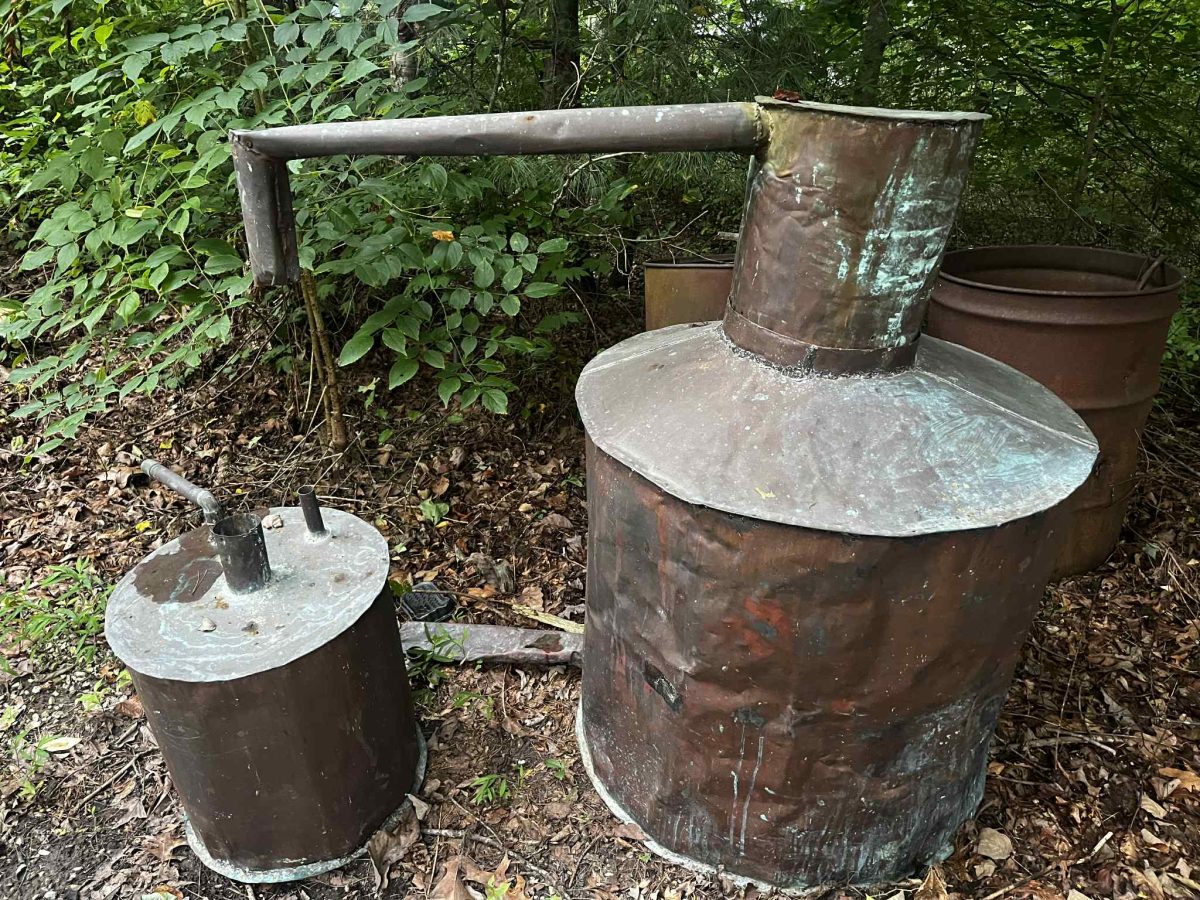
If you’ve driven by Oneida City Park lately, you’ll have noticed the remarkable renovations to the old depot. New paint, windows, and doors have begun to bring an historic structure to 21st Century life. The building, with its own storied past, will be the eventual home to the Museum of Oneida and Scott County, a sizable local undertaking, whose collection is currently housed for public display inside the Black Cat at 250 South Main Street. Already the home of a slew of interesting and historic artifacts – and story after entertaining story, if you take a moment to listen to proprietor Moe Mullis – in June, SCN reached out to Oneida Mayor Lori Phillips-Jones hoping to add another. Its origins deeply marinated in the mountainous hollers of McCreary County, Kentucky, heavily steeped in local lore of a storied artform that encompasses the Appalachian South, where the mountains press close and the law can feel far away. As you might have guessed, in stepped a moonshine still with an interesting provenance. When SCN reached out, it just so happened the still, which had long been a tourist favorite at the Big South Fork Motor Lodge in Stearns, Kentucky – was looking for a permanent home. The Oneida Museum seemed the perfect one.
The story starts deep in hill country, plunged in the throes of the Great Depression, with a legendary figure named Alonzo “Lonzo” Stephens. By the time Stephens made headlines outside the area – even making the Lexington, Kentucky newspaper – he’d been running moonshine for 60 years and was already a fabled character in and around McCreary County. By the time deputies came knocking in the early 1990s, Stephens was already in his seventies, stooped in years, perhaps, but still running a copper still the way he had since the 1930s. During those years, Kentucky was a leading producer of what was called “mountain alcohol,” and stills, like those belonging to Stephens, were tucked in wooded hideouts all across the state.
Stephens’ operation, as law enforcement might have told you, wasn’t small. Tucked into the hills, and bubbling with sour mash, were the master moonshiner’s beautifully crafted copper stills. Nearby, always, were Mason jars of clear, fiery liquor that locals swore was the best in a dry county. “You could cut it with creek water and still feel the burn,” one old-timer remembered, a grin flashing at the memory. “You don’t want to know what other people put in theirs just to compete with Lonzo,” one McCreary Museum goer once cautioned.
“I never really made much money at it,” Stephens -an Army veteran, who once guarded Presidents Roosevelt and Truman – told the Lexington Herald-Leader in 1991. “I just tried to keep food on the table. I probably give away more than I ever sold.”
Perhaps, that was part of his legend – presentation and generosity. “Lonzo just didn’t go out here and use old drums or pick up rusty pipes along the railway,” the McCreary County Judge-Executive Jimmie W. Greene (1928-2017) once said. When the County Sheriff finally did haul Stephens in, folks didn’t exactly rush to condemn him. In fact, a judge once tossed the case against Stephens from court and put the sheriff who had arrested him in jail.
“Lonzo never hurt nobody,” was – and is – a common adage.
For many in McCreary County, Stephens’ whiskey wasn’t contraband; it was culture, passed down through generations. “And Lonzo made some of the finest moonshine you could find in Kentucky or Tennessee,” Greene, the father of the current County Judge, said. “Making moonshine is art and Lonzo is ‘state of the art.’”
In the end, Stephens may have gotten the last laugh. The McCreary County Sheriff once displayed one of Stephens’s confiscated still at the courthouse like a prized ribbon until another judge demanded it be returned to the moonshiner. “Only in McCreary,” one local said. Funnier yet, while locals in McCreary and surrounding counties purchased their share, word on the ‘shine got out. According to a tale Stephens himself told, folks were driving in from Florida and Georgia and as far away as New England. One still – now housed at the McCreary County Museum – even appeared as a clue on TV’s Jeopardy in 2017.
Lonzo’s legend is simple. For many in Kentucky and Tennessee, moonshining was survival. Farmers turned corn into whiskey, both to make a living, as Stephens often said, and to dodge government taxes. And when revenuers came sniffing, as they did during Prohibition, moonshiners knew how to vanish into the trees down on the river or hit the country backroads fast. The need for speed birthed something bigger. The same souped-up Fords that once carried jars of white lightning would later roar onto dirt tracks, giving rise to NASCAR. Moonshine built both a livelihood and a sport.
Alonzo Stephens, who died in 2001, aged 81, may never have driven Talladega, but his story belongs to that same restless spirit: defiant, patriotic, ingenious, and rooted in the hills. To locals, he wasn’t an outlaw — he was a reminder that tradition runs as clear, and as strong, as the liquor in a Mason jar.
For his family, he was simply dad. “He was the best dad and family man and friend to all who knew him,” his daughter, Kimberly Stephens, told SCN. “And the number one moonshine maker in state of Kentucky.”