Cumberland Clear sets sights on landfill fight
PROTECTED CONTENT
If you’re a current subscriber, log in below. If you would like to subscribe, please click the subscribe tab above.
Username and Password Help
Please enter your email and we will send you a password reset link.
Cumberland Clear sets sights on landfill fight

Photo by Shane Gilreath
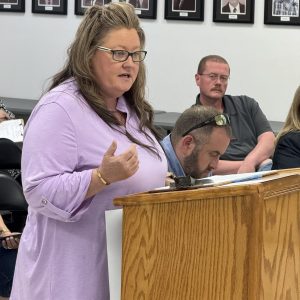
When Cumberland Clear hosted a meeting at Timber Rock Lodge last week, dozens of concerned citizens from Scott and McCreary Counties showed up hoping to throw their efforts into helping the organization with issues involving the proposed secondary landfill. Local resident Tiffani Harmon expressed deep concerns for already polluted waterways.
Proposed development turned citizens to activists
By Shane Gilreath
“My family in Europe were shocked,” said Kathy Obrusanszki, president of the recently formed Cumberland Clear, whose mission opposes the proposed landfill that has already raised alarming levels of controversy. Speaking at the organization’s planning meeting at Timber Rock Lodge on July 28, 2025, Obrusanszki, who visited in-laws overseas this summer, said she had kept abreast of happenings at home, telling her family about the developments that have drawn such criticism throughout Scott County.
While landfills remain active in Europe, they are increasingly less common. The European Union’s approach has been – much like the recent Scott County Chamber of Commerce resolution – one of ultimate prevention and solution. According to the EU’s Waste Hierarchy, who aims to minimize environmental impact and promote sustainable waste management practices across the continent, landfills are the least preferable option for waste management and should be limited to the necessary minimum. As a result, between 2010 and 2020, the total waste sent to European landfills decreased by 27.5%, a reduction of nearly 50 million tons. In the decade examined by Eurostat, the official statistics office of the EU, household waste in landfills decreased by 57%, combustion waste by 30%, and “other waste” by 28%. Many of the solutions come in the form of recycling and incineration, with the latter method potentially reducing waste by 95% (albeit linked to air pollution).
Not only could what’s going on in Scott County not happen in Europe, but it would not be legal in New York, Obrusanszki maintained: “It’s affecting our land, our air, the water and rivers we’re catching fish from – for generations.”
When Cumberland Clear met last Monday, there were representatives of many of those generations, young and old and generations in between. Some fought back tears, telling stories of environmental pollution in local waterways, alarming cancer rates, and grandchildren and families who live in proximity of Volunteer Regional Landfill and the proposed new site.
“This is something our entire community should be doing,” Obrusanszki said, citing potential contaminates already being brought into the Scott County area. “We are already getting coal ash on dump trucks,” she shared. “Now, we’re going to be getting train loads.”
Coal ash, which Obrusanszki referenced, is a radioactive material that contains contaminants like mercury, cadmium and arsenic. Without proper management, these contaminants can pollute waterways, ground water, drinking water, and the air, causing catastrophic events. One such notable occurrence took place just an hour’s drive away – when a failure in a dike used to contain coal ash occurred at the Tennessee Valley Authority Kingston Fossil Plant in Harriman – pouring over a million gallons of toxic coal ash into the Emory River in 2008.
In a 2023 Risk Assessment, the United States Environmental Protection Agency (EPA) found cancer risks exceeding health standards when coal ash is mixed with soil at ratios that include very small amounts of coal ash. By the 10 year anniversary of the Kingston spill, dozens of the workers charged with the cleanup had died from brain cancer, lung cancer, leukemia, and other diseases. Many of those who had not succumbed to illness bore obvious scars: the use of canes, inhalers, and blisters from arsenic burns on their skin were all cited as part of lawsuits filed against TVA, which were settled in favor of the workers in 2023. The terms of that settlement were confidential.
“If you live anywhere near the railroad, that’s now a dump. It doesn’t have to be tarped. There are no regulations for transfer stations and it’s a football field away from Winfield Elementary,” Obrusanszki charged. “It’s in the dirt they’re playing in.”
To combat this and other potentially hazardous issues related to the proposed landfill, Cumberland Clear began forming committees to study and fund their fight. Just last month, Knox Horner, who has been the public face of the landfill, said that a permit had been issued by the Tennessee Department of Environment and Conservation (TDEC) and that construction would begin in September. “Horner has lied, plain and simple,” Obrusanszki said. “That’s not happening.”
As previously reported, TDEC’s Nick Lytle told SCN: “Law states that if the landfill doesn’t construct within one year of the permit date, they must recertify prior to construction and waste placement. That is where this permit currently resides,” Lytle said. The previous claim that the landfill has a permit is technically true, given the 2010 issuance, according to Lytle, but that permit – granted to Roberta Landfill Phase II – has not, as yet, been recertified as required. TDEC’s division for Solid Waste Management did receive a request to recertify on July 3, 2025, according to TDEC Senior Communications Advisor Jennifer Donnals, but have not formally responded.
“There are major flaws on that permit,” asserted Ralph Trieschmann, owner of Timber Rock Lodge, from which the proposed landfill site can be seen. Trieschmann, an active participant with Cumberland Clear, has been a vocal opponent of the Horner landfill. Seeming to verify Trieschmann’s claim, Donnals indicated to SCN that following a preliminary examination of the request that there had been a rule violation.
“The Roberta Phase II Landfill permit, per the terms of the facility specific conditions, shall not become effective, and no construction within the footprint may commence unless and until all required Aquatic Resource Alteration Permits (ARAPs) have been issued to mitigate the rule violation,”Donnals told SCN. When questioned in a Scott-McCreary Environmental Coalition meeting last month, Horner indicated to Cumberland Clear’s Jennifer Shockley that ARAP permits were in order, seemingly contrary to Donnals’ statement.According to Donnals, TDEC rules require a Class I Disposal Facility, which Horner has confirmed, must be located, designed, constructed, operated and maintained such that the landfill areas are, at a minimum, 200 feet from the boundaries of springs, streams, and lakes. An ARAP permit is issued under Tennessee law and authorizes the alteration of bodies of water, which could become problematic for landfill developers where water quality is negatively impacted.
In addition to these concerns, Donnals said that a recertification instruction letter sent on February 6, 2025, stated that TDEC required a revised closure and post-closure care plan that recalculates the cost for a third-party closure and long-term post-closure care. Donnals subsequently told SCN that such plans appears to be absent from the July 3, 2025, recertification request.
According to the EPA, when a landfill stops receiving waste at the end of its active life, it must be cleaned up, closed, monitored, and maintained in accordance with the Resource Conservation and Recovery Act’s closure and post-closure care requirements. Those plans become part of the waste facility’s operating permit. All closure plans must include: a description of how each hazardous waste management unit will be closed; a description of how final closure of the facility will be achieved; an estimate of the maximum amount of hazardous waste kept on site during the facility’s operating life; a detailed description of closure methods, including waste removal and site decontamination;a description of any other required steps, such as groundwater monitoring and leachate management; and a schedule of closure dates, including closure dates for each unit and the entire facility.
Post-closure care is required for landfills that leave waste in place upon closure. These sites must monitor and maintain liners, final covers, leachate collection and removal systems, leak detection systems, and gas collection systems to protect the surrounding environment and population from releases of hazardous components. The standard post-closure care period is 30 years. In applying for a permit, a facility must complete and submit a post-closure care plan. Among other things, this plan must include a description of the planned groundwater monitoring program and a description of planned maintenance activities for the waste containment systems (e.g., liners, final covers, leachate management systems).
Despite alleged flaws in both the permit and recertification requests, the waste and recycling industry, which includes landfill operations, remains an enormous enterprise in the United States. According the EPA, the industry generated $104.63 billion in revenue in 2024. This figure shows a significant growth from previous years, indicating a robust market for waste management. For those, like Cumberland Clear, the cost comes at an expense.
“The thirty pieces of silver ain’t worth it,” Trieschmann said.