State Tourism Addresses Scott County
PROTECTED CONTENT
If you’re a current subscriber, log in below. If you would like to subscribe, please click the subscribe tab above.
Username and Password Help
Please enter your email and we will send you a password reset link.
State Tourism Addresses Scott County
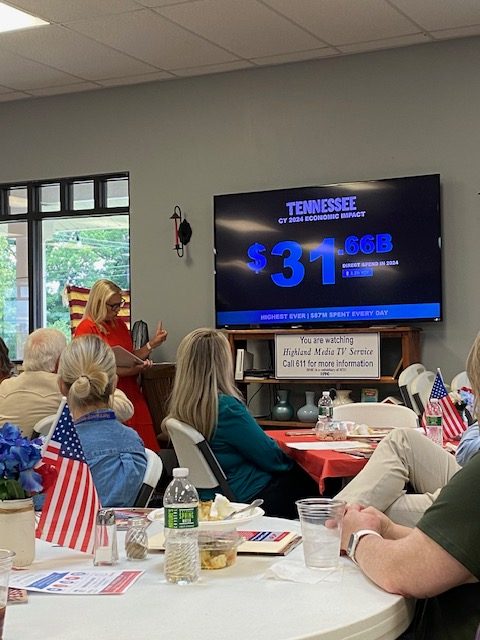
Photos by Ruthie Mullett Melanie Beauchamp, the State Tourism Department’s Assistant Commissioner of Rural Tourism and Outreach, gave a presentation to the Chamber of Commerce, showcasing the importance of tourism and how it impacts both the state and Scott County.
By Shane Gilreath
SCN Contributing Editor
[email protected]
As evidenced by the recent visit by Melanie Beauchamp from the Tennessee Department of Tourist 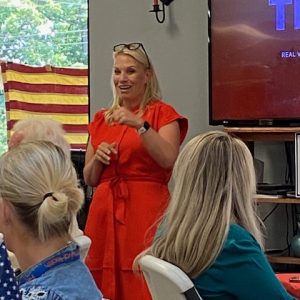 Development, tourism is an industry that continues to define Tennessee and emerge as one of state’s most viable economic boosts. This continues as Scott County positions itself to benefit from the broader momentum.
Speaking recently to the Scott County Chamber of Commerce, Beauchamp outlined the continual growth of tourism across the state and the opportunities it makes available to communities willing to invest in the industry. According to Beuchamp, who serves as the Assistant Commissioner of Rural Tourism and Outreach, Tennessee was the only state in the entire nation to see a climb of four places in the national tourism ranking, making it second in the country in visitor spending and the fastest-growing state without a beach. According to her figures, in 2024 alone, tourism generated nearly $32 billion for Tennessee’s economy in direct visitor spending. The state welcomed 147 million visitors from 95 countries. This marked a 3.3% year-over-year increase and36.6% growth since 2018, outpacing the national average.
The impact extends well beyond the state’s major destinations, however, and Beauchamp noted that every $1,000 spent by visitors generates approximately $96 in state and local tax revenue, dollars that ultimately return to local communities through public services and investments.
Scott County is already seeing the benefits. Overnight visitation contributes an estimated $44,000 to the local economy, while day visitors account for approximately $83,000 in spending. That figure is particularly noteworthy because tourism professionals traditionally focus on putting “heads in beds” through overnight stays. Scott County’s ability to attract significant day-trip traffic demonstrates the growing appeal of its outdoor recreation opportunities, coupled with an increase in shopping, dining, and community events, which have noticeably increased with the performing arts.
Oneida, in particular, has embraced the arts as a tourism driver. The city continues to promote both the performing arts and visual arts, recognizing that culture and creativity are increasingly important components to travelers. The in-progress mural on the bridge overpass near Oneida Park and the new history museum therein provide both local identity, as does the new Veteran Memorial Park in Huntsville, which can be an important component to tourism, and added points of interest for visitors.
Recent years have also seen an explosion in adventure tourism, an industry that represents a promising opportunity for the county. Groups continue to advocate for and work to develop a rail-trail system, an amenity that could attract hikers, cyclists, runners, and additional outdoor enthusiasts, despite a push back from many locals.
Beauchamp estimated that tourism already generates millions of dollars in economic benefit to the county, aided by continual commercial growth. The Assistant Commission praised the idea and promotion of regional staycation destinations (see Page 9A), noting that encouraging residents to explore nearby attractions keep tourism dollars circulating within local communities and ultimately strengthens regional tourism partnerships.