Cumberland Clear Eyes Litigation, Data Centers
PROTECTED CONTENT
If you’re a current subscriber, log in below. If you would like to subscribe, please click the subscribe tab above.
Username and Password Help
Please enter your email and we will send you a password reset link.
Cumberland Clear Eyes Litigation, Data Centers
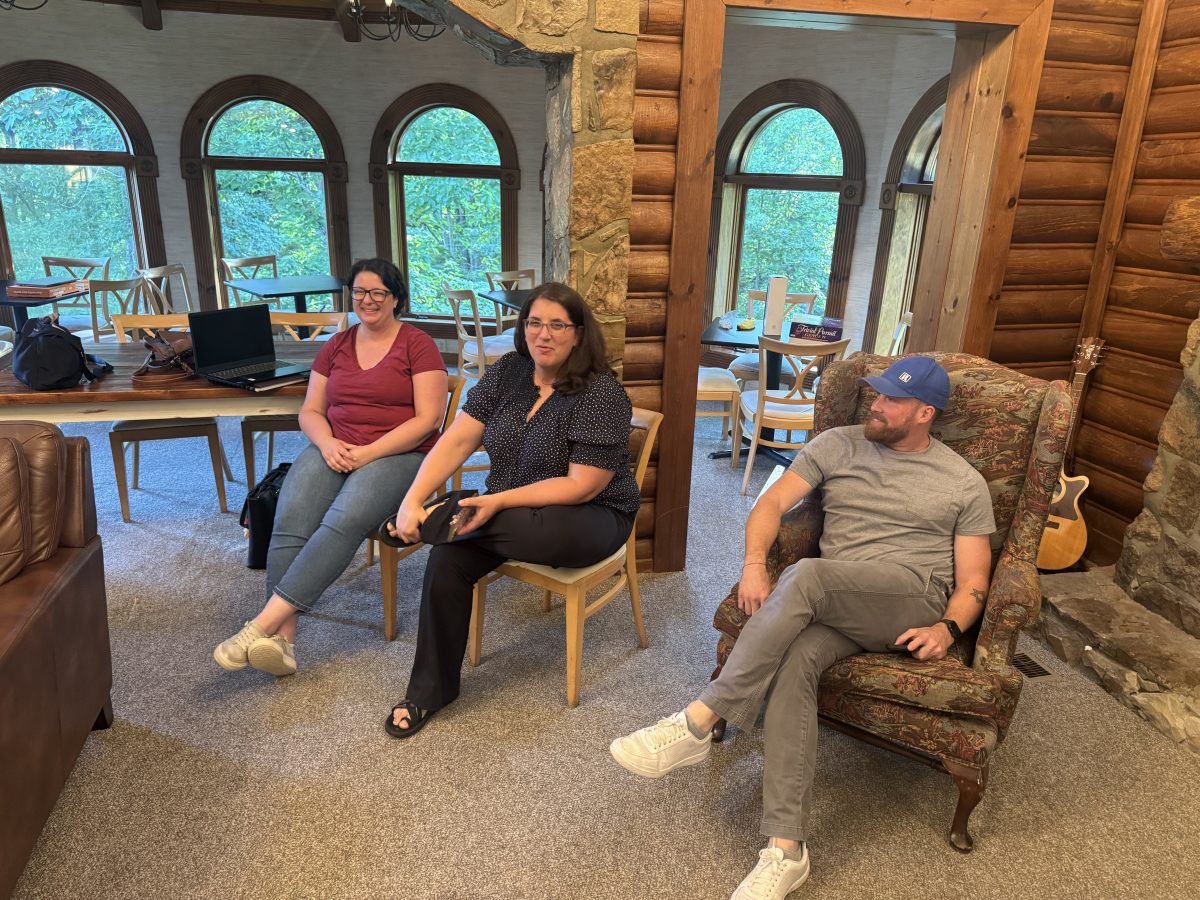
Photo by Shane Gilreath
Cumberland Clear’s Treasurer Alison Cowen and President Jennifer Shockley each addressed issues surrounding the Roberta II project and data centers at the organization’s meeting. They were joined by Scott County native Seth McMillan, who is running for State Representative.
By Shane Gilreath
SCN Contributing Editor
[email protected]
When Cumberland Clear met at Timber Rock Lodge on June 23rd, the citizen organization, which first formed in opposition to the proposed Roberta II landfill, found itself returning to business as usual, while also taking on what members believe could become Scott County’s next big environmental challenge.
Organization President Jennifer Shockley, who has led the volunteer-based organization for nearly a year, told members that additional litigation in the Roberta II dispute remains likely, though Cumberland Clear has yet to file such a suit. Instead, she said, the organization is waiting on the outcome of Roberta II’s appeal of the denial of their Aquatic Resource Alteration Permit (ARAP),which was filed with the Tennessee Department of Environment and Conservation (TDEC) in early June.
“We can contest that appeal as Cumberland Clear,” Shockley, who is a current candidate for County Mayor, had previously said, explaining that doing so would give Scott County residents a direct voice in the legal proceedings. “And we are having those discussions.”
Although attendees expressed appreciation that Cumberland Clear was prepared to continue a legal challenge, there was noticeable frustration that the Scott-McCreary Environmental Coalition (SMEC) has yet to initiate litigation, despite each participating government previously voting in favor of doing so. That sentiment seemed to resonate throughout the meeting as numerous attendees voiced their agreement while others simply nodded in support. In April, the Scott County Commission, the McCreary County Fiscal Court, and the municipal governments of Oneida, Huntsville, and Winfield each separately approved resolutions supporting litigation concerning the proposed landfill.
While Roberta II remains the organization’s primary focus at the moment, much of the meeting centered on an issue that Cumberland Clear believes communities should begin addressing before large-scale development arrives. Treasurer Alison Cowen updated members on the organization’’s growing concern over data centers, an issue she has recently presented before several local governmental bodies. Cowen has encouraged local officials to begin considering ordinances that could regulate or slow future development and has advocated for a temporary moratorium while the county studies the issue.
Scott County already hosts two bitcoin mining operations, though both are considerably smaller than the hyperscale data centers being proposed elsewhere around the country. Discussion during the meeting included Clean Spark, the company operating facilities locally – one in Winfield and one in Oneida – perhaps naming the company publicly for the first time.
“There are a lot of pieces that need to be received,” Cowen said in discussing the types of local ordinances that governments could adopt.
The concern, she explained, extends well beyond the buildings themselves. Modern data centers require extraordinary amounts of electricity and water to operate, particularly those supporting artificial intelligence (AI) computing. Studies estimate that U.S. data centers could consume as much as nine percent of the nation’s electricity by 2030, more than double their current share. Utilities across several states have already proposed billions of dollars in new power plants and transmission infrastructure to meet that demand, leading consumers to fear that residential customers could ultimately bear part of those costs through higher electric rates if regulators don’t require the largest users to pay a greater share.
“Data centers have a lot of the same issues as landfills,” Cowen warned.
While Cowen’s message is debated in the industry, research has identified environmental and public health concerns associated with large facilities. Besides their enormous electricity demand, many data centers require millions of gallons of water annually for cooling systems. Backup diesel generators can contribute localized air pollution during testing or emergency operation, while cooling equipment often produces continuous low-frequency noise that nearby residents have reported affects their quality of life. Environmental organizations have likewise warned that rapidly increasing electricity demand can extend reliance on fossil-fuel power generation in regions where renewable energy sources cannot yet keep pace.
“Let’s get ahead of this,” Cowen urged both the organization and Scott County itself.
The discussion around such centers prompted comments from Seth McMillan, a Scott County native who is seeking his party’s nomination for State Representative.
“We know there’s an environmental impact,” McMillan, who would challenge Rep. Kelly Keisling, said. “Wouldn’t it be effective to propose legislation to start appropriately limiting them?”
McMillan said he believes the issue has become significant enough that Tennesseans would support statewide legislation establishing limits or additional oversight for future data center development.