Task Force Talks Zoning, Landfills, and Axing Jackson Law
PROTECTED CONTENT
If you’re a current subscriber, log in below. If you would like to subscribe, please click the subscribe tab above.
Username and Password Help
Please enter your email and we will send you a password reset link.
Task Force Talks Zoning, Landfills, and Axing Jackson Law
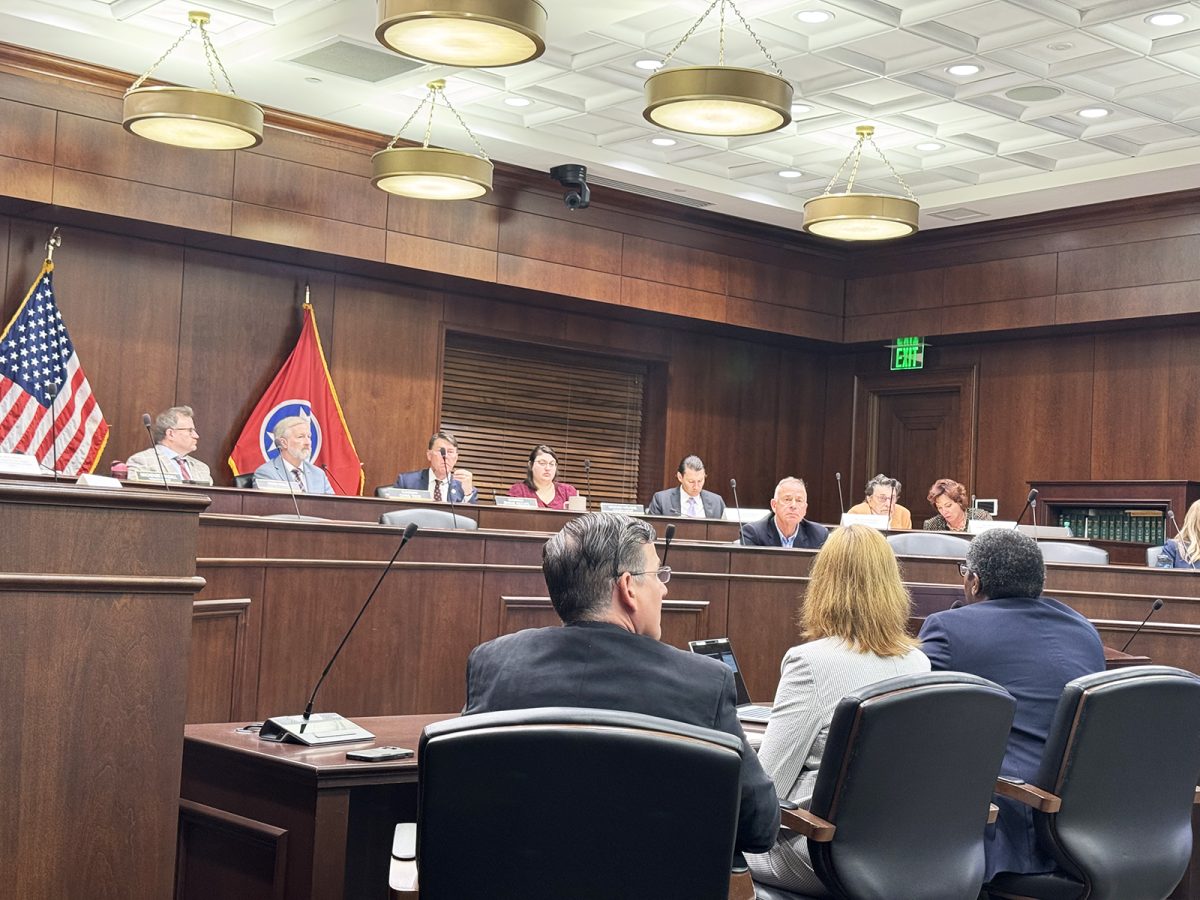
Photos by Shane Gilreath Nearly a dozen faces from Scott County appeared at the meeting of the Tennessee Solid Waste Task Force in Nashville last week. The committee discussed proposals to deal with solid waste and Jackson Law before opening the floor to public comment. Those in attendance included Cumberland Clear President Jennifer Shockley, Michelle Trieschmann, Lisa Cotton, Seth McMillan, Ruth Massengale Thompson, Ralph Trieschmann, and Wendell Trammell.
By Shane Gilreath
SCN Contributing Editor
[email protected]
Outside, on John Lewis Way in downtown Nashville last Tuesday, the heat and humidity were already climbing. Inside the Cordell Hull Building, however, roughly a 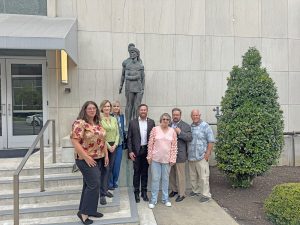 dozen Scott and McCreary County residents sat in the air-conditioned chill of Hearing Room 3 waiting to hear testimony before Tennessee’s Solid Waste Task Force, what the committee might recommend and what those recommendations could mean for communities like Scott County who are battling the waste industry for a voice in their hometowns.
It was created in 2025, the state gave the task force three years to examine Tennessee’s long-term waste management needs and develop a strategy for managing that waste through 2050, but to do so was a conundrum. Tuesday’s meeting outlined those needs, the trouble in implementation, with a heavy focus on several issues seen as pertinent for Scott County.
For watchful residents, there’s a particular interest in the future of Jackson Law – the opt-in law, which some legislators would like to abolish, gives local governments a voice in whether new landfills and other solid waste facilities are permitted in their own backyards. The law, which was hammered home repeatedly on Tuesday, was originally enacted to provide counties lacking zoning regulations with a mechanism to review and approve landfill proposals. Over time, however, it has become one of the strongest local-control measures in the nation, which seems to make legislators leery.
As of January, 54 counties and 18 cities have adopted Jackson Law’s protections, but recent discussions among legislators and industry insiders have raised serious questions with many thinking those powers should be narrowed, altered, or by some accounts, even eliminated.
As a result, for those in attendance on Tuesday, the hearing sometimes felt like a study in a government stereotype, with legislators and other committee members debating whether Nashville knew better for local communities than the communities knew for themselves. To those listening, it recalled the words of President Ronald Reagan: “The nine most terrifying words in the English language are: ‘I’m from the government and I’m here to help.’” Should Jackson Law be eliminated, it could be a nightmare scenario for Scott County and its fight against Roberta II, which has been widely criticized by locals, heavily questioned by the National Park Service and subsidiary groups, governments in neighboring Kentucky, environmentalists, schools, and residential areas that are within shouting distance to the proposed site.
For those residents, the idea of handing over a local control that could operate as checks and balances sits as a frightening reality, but appeared to have support among many of those who testified before the task force. Despite extensive discussion about zoning and local planning – and the seeming importance of it – much of the conversation focused on making it easier to develop additional landfill capacity across the state.
“We absolutely have to have a partnership with local governments in order to build these facilities, but the reality is, right now, it’s almost impossible,” said RJ Gibson, Director of Government Affairs for the Tennessee Chamber of Commerce. “It’s very, very difficult to bring new capacity online as a matter of math and economics, we’re going to need more solid waste capacity in the state, we just are. And so we have to have a system that allows us to add that capacity.”
The problem, insofar as many lawmakers and industry representatives see it, is that too many communities are exercising the powers already afforded to them under the Tennessee law and refusing to embrace new landfill proposals or the expansion of existing facilities. Just as Scott County has tried to do. To opponents of Jackson Law, local governments have become obstacles. To the citizens who packed Hearing Room 4, those same local governments are performing exactly the function they were intended to perform – serving as a check against outside interests and protecting the people who must live with the consequences of the waste industry long after permits are approved and profits collected.
That philosophical divide was on full display as lawmakers discussed the barriers facing the solid waste industry.
“It’s really easy to say ‘no’ to everything, but you still have a problem that you have to deal with, and I believe we’re seeing a lot of that when people say, ‘well, we don’t want it,” said Rep. Rusty Grills, “It really gets under my skin.”
For many Scott Countians – and communities like ours – Grills’ comments would have landed poorly. The legislator had already become a controversial figure during debates over HB 2202 earlier this year, and residents who have spent months fighting Roberta II could easily have viewed such remarks as further evidence that Nashville sees local opposition not as citizen empowerment, as they do, but as an inconvenience for them to overcome.
Rep. Chris Todd, co-chairman of the task force, an equally controversial fellow in Scott County who has garnered the nickname “Trashy Todd” for some locals – offered a reminder of the property rights concerns at the center of the debate, something he has long espoused.
“For all of us, certainly representatives and senators, we got to look out for our constituents, and what’s in their pockets, it’s their property that our decisions here can affect what’s in their pockets,” Todd said, who has been accused of ignoring the desire of Scott County.
Earlier this year, Todd likened Scott County citizens to a mob during discussions surrounding the local opposition to Roberta. To many of those who traveled to Nashville last Tuesday, Todd’s talk of protecting property rights rang hollow, especially when compared to Todd’s legislative efforts and his current involvement in discussions that could strip communities of one of the few meaningful tools they possess to protect their own rights.
By day’s end, the strongest voices were not from Grills or Todd however, but from Scott County itself.
Seth McMillan, who is seeking a seat in the Tennessee House, spoke of Scott County legacy of loving neighbors and taking action at the local level. “The impact from corporate polluters of the past,” McMillan said, “are still felt today in the lives of Scott Countians. When the timber mill, coal mining, and rail corporations shut down local operations, they left behind economic distress, stripped land, and high cancer rates from pollution of the water supply. The profits are long gone, but the people of Scott County remain to clean up the mess that was created by their former employers. Our land and our people were exploited, plain and simple. We look back and wish our neighbors had pushed back harder at the time. That was then, but this is now. We have decided to act differently this time. Unified together as a community of neighbors, leaders, and business people. We remain opposed to the Roberta II landfill permit.”
Jennifer Shockley, president of Cumberland Clear, warned lawmakers that eliminating local control would disproportionately affect counties without countywide zoning. Noting that 49 of Tennessee’s 95 counties lack countywide zoning codes, including Scott and neighboring counties, she argued that Jackson Law remains an essential safeguard.
“Jackson Law recognizes that communities deserve a seat at the table when decisions are being made about the economic future they have so carefully built for themselves,” Shockley said. “The decisions you make here are not just about waste disposal. It’s about economic strategy. It’s about community identity. It’s about opportunity. But most importantly, it’s about the future we choose for every county in Tennessee.”
Michelle Trieschmann, proprietor of Timber Rock Lodge, urged the task force to preserve both Jackson Law and protections contained in the Scenic Rivers Act. “These laws are not merely about landfill location, but about preserving local input,” Trieschmann said. “They help restore balance to a process where the people with the greatest stake in the outcome often have the fewest resources to influence it.”
Ralph Trieschmann, speaking on behalf of the Scott County Chamber of Commerce and as Chair of the Oneida Industrial Development Board, argued that tourism represents Scott County’s future.
“The natural resources we have there are vital to our future and we don’t want to see them squandered, especially when we have already taken care of our needs,” he said. “The Scott County Solid Waste Board – while tiny in region is mighty in use – has figured out a plan to not only take care of Scott County’s waste, but also Morgan, Campbell, and part of Knox. We have a regional landfill already in our county and we don’t need another one, but we do need a voice to say “we don’t need another one.’”
Despite Trieschmann’s argument, legislators have expressed interest in moving Tennessee toward larger regional waste systems – creating broad regional boards to serve regional needs. Scott County, however, already functions as its own solid waste region board, chaired the Winfield Mayor Jerry Dodson. For Scott County, it’s vital to keep that in place. Under the current law, solid waste boards can determine whether proposed landfill projects fit within their plans.
At the end of the day, the meeting underscored a growing concern across the nation – that decisions affecting communities may increasingly be made by people far removed from them. If there was one message repeated often enough to warrant remembering, it was that local communities want to retain the ability to decide for themeselves before Nashville decides it for them.