Ecology Park or Landfill? Trans-Rail Rebrands Roberta II
PROTECTED CONTENT
If you’re a current subscriber, log in below. If you would like to subscribe, please click the subscribe tab above.
Username and Password Help
Please enter your email and we will send you a password reset link.
Ecology Park or Landfill?
Trans-Rail Rebrands Roberta II
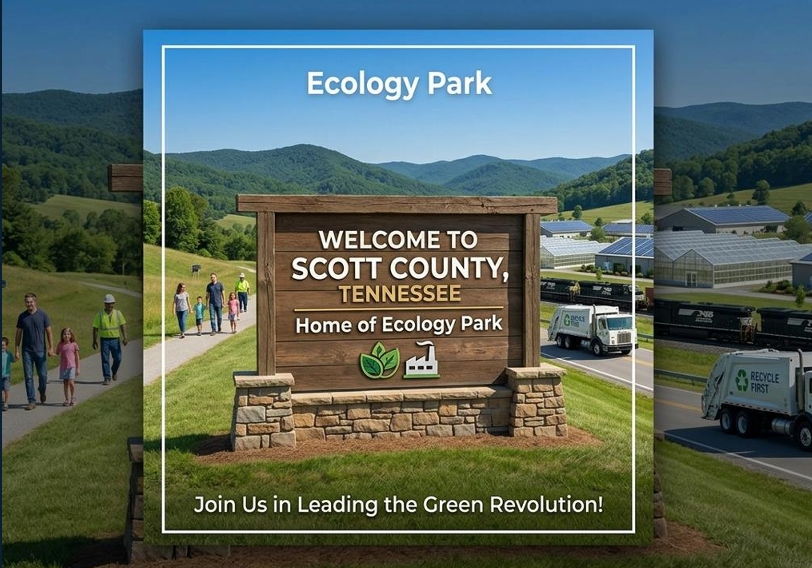
SCN received a pamphlet last week showing what appears to be a rebranding effort for the Roberta II landfill project, turning it decidedly from what could be the second largest landfill in America to a family friendly Ecology Park that welcomes visitors to Scott County.
By Shane Gilreath
SCN Contributing Editor
[email protected]
If you weren’t paying close attention, you might think Trans-Rail Waste Services was unveiling plans for a family-friendly theme park attraction rather than one of the most controversial landfill proposals Scott County has ever seen. The company’s promotional materials repeatedly refer to the Roberta II project as an “Ecology Park,” complete with photographs and renderings of smiling families walking through green spaces, educational programs, watershed restoration projects, and promises of environmental stewardship. The presentation emphasizes recycling, rail transportation, public education, and ecological restoration, describing the project as an “integrated, rail-connected recycling and disposal platform” designed to create both economic and environmental benefits.
Missing from much of the marketing language is the fact that the proposal remains, at its core, a massive Class I landfill project – one that opponents have long argued could become one of the largest landfills in the entire nation. The timing of the (re)rebranding is noteworthy. Roberta II is currently attempting to move forward after the Tennessee Department of Environment and Conservation (TDEC) rejected its Aquatic Resource Alteration Permit (ARAP) application and raised significant concerns about the project’s environmental impacts.
Much of Trans-Rail’s new pitch focuses on solving statewide waste management challenges, issues that are surely to appeal to TDEC and the State Solid Waste Task Force. Company materials argue that Tennessee faces limited landfill capacity, uneven access to recycling facilities, and growing transportation costs. By combining a materials recovery facility, rail transportation network, and landfill operation into a single site, the company says it can reduce truck traffic, expand recycling opportunities, and generate economic benefits for Scott County.
It’s unclear whether such a marketing strategy will be successful. From landfill to seeming tourist destination seems a heavy jump, and critics may view the “Ecology Park” branding as an attempt to soften public perception of a project that remains fundamentally tied to waste disposal.
The rail-transfer component, for example, has not disappeared. Trans-Rail Waste Services, whose proposed manager is Knox Horner, the controversial public face of the Roberta II project, continues to advance plans for a rail-transfer station in Winfield. That facility would allow waste to be shipped by rail to Scott County from virtually anywhere in the country, an operation that would take place within a football field’s length of Winfield Elementary and Scott County students. That alone has been an issue that has drawn ire from school officials. Outgoing Director of Schools, Bill Hall, has been an outspoken critic, though company documents state that Norfolk Southern has already approved the rail concept in late 2025.
The presentation also highlights stream and wetland mitigation as evidence of environmental responsibility. Mitigation, as previously reported by SCN, refers to efforts intended to offset environmental damage by restoring, creating, or enhancing natural resources elsewhere. In theory, mitigation allows development projects to compensate for unavoidable impacts. In practice, however, mitigation proposals are far more controversial and are often among the most contested aspects of environmental permitting because regulators must determine whether artificial replacements can truly replicate natural ecosystems. That concern has been central to TDEC’s rejection of the Roberta ARAP. They questioned Roberta’s reliance on French drain systems to replace impacted streams, expressing doubt that the approach would maintain long-term hydrology. French drains have long been controversial within environmental and waste-management circles because they replace natural stream systems with buried infrastructure that can create uncertainty, long-term maintenance concerns, and future regulatory liability.
TDEC went further, rejecting the applicant’s proposed mitigation plan and requiring approved stream credits instead. The agency also cited concerns regarding restoration methods, land protection mechanisms, stream relocation documentation, plant species selection, and potential impacts on protected wildlife.
Despite those setbacks, Trans-Rail’s materials continue to promote significant economic incentives, including projections of $1 million annually for Scott County, another $1 million for the City of Oneida, and more than 50 permanent jobs, a number that is higher than that which Horner first told SCN last May.
As the project moves along with some stealth, whether officials and residents see an innovative environmental project or a controversial landfill wrapped in a prettier package may ultimately determine the future of Roberta II.