Anderson County says, “Yes” to Rail-Trail. Is Scott County Next?
PROTECTED CONTENT
If you’re a current subscriber, log in below. If you would like to subscribe, please click the subscribe tab above.
Username and Password Help
Please enter your email and we will send you a password reset link.
Anderson County says, “Yes” to
Rail-Trail. Is Scott County Next?
By Shane Gilreath
SCN Contributing Editor
[email protected]
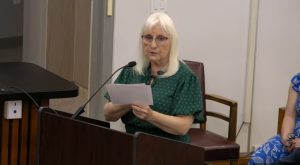
Nancy Manning, Executive Director of Tennessee Citizens for Wilderness Planning, addresses the Anderson County Commission on May 18th, telling the commissioners that her organization planned to turn their attention to Scott County next.
The proposed Rail Trail project, which could directly impact Scott County, received a major endorsement from Anderson County during the County Commission’s May meeting, where commissioners unanimously passed a resolution supporting efforts to convert the abandoned 42-mile rail corridor from Oneida to Devonia into a recreational trail.
The resolution, drafted by Nancy Manning, Executive Director of Tennessee Citizens for Wilderness Planning (TCWP), mirrors similar resolutions already passed in Clinton, Norris, and Oak Ridge. A comparable proposal is expected to be introduced to municipalities within Scott County, where the project has generated significant controversy among landowners and residents.
In early 2025, Scott County voted unanimously to oppose the project. In August, the County Commission voted to reject an offer to meet with the Trust for Public Lands (TPL) about the project. County Mayor Jerried Jeffers has proven critical of the tourism project, telling SCN in January 2025 that it was private land, but neighboring Anderson County heard both sides of the argument from the public before taking official action.
That resolution, which passed to applause, formally recognized the abandonment of the former Tennessee Railroad line by R.J. Corman and supports efforts by TPL to acquire the corridor under a federal Notice of Interim Trail Use, which, according to Manning, is set to take place in December 2026. The measure, which could mirror one presented to Scott County, specifically states that it does not include any financial commitment from the county.
“On April 27th, the 42-mile rail corridor was successfully rail banked under federal law,” Manning said during the May 18th meeting, telling commissioners that her organization has worked since 2020 to preserve the historic rail corridor while conducting public outreach in communities along the line. “Railbanking preserves the corridor, in tact, for possible future rail use and allows for recreational trail use.”
The proposal also highlights possible infrastructure improvements for the New River community, including water service upgrades, emergency response access, public safety support, and the possibility of a unique zip code.
Supporters of the project pointed to the economic success of similar rail-trail conversions elsewhere in Appalachia, particularly the Virginia Creeper Trail in Damascus, Virginia. The 34-mile Virginia Creeper, created from a former railroad corridor that once hauled timber and iron ore through the mountains, has become one of the most successful rail-trails in the country.
According to a 2025 Virginia Tech economic impact study, the Virginia Creeper Trail attracts more than 300,000 annual trail uses and generates approximately $61 million annually for surrounding communities through lodging, restaurants, bike rentals, and tourism-related spending. Researchers estimated the trail supports roughly 582 jobs and generates more than $2 million in local tax revenue, stats that have led to significant arguments in support of a Scott County Rail-Trail involvement.
Several New River residents told commissioners they believe the trail could provide badly needed economic activity and recreation opportunities for struggling communities along the tracks.
Davonia resident Loretta Webber admitted that when she first heard of the project, she was opposed to it. “The reason I didn’t want it is because we don’t like change,” Webber said. “The more I learned,” she said, “the more I liked, then I figured out this could be good for us.”
Webber and others recently traveled to Damascus to see firsthand how the Virginia Creeper transformed tourism in southwest Virginia. Despite the Virginia visit, some residents have expressed concerns over increased traffic and outside influence in the rural New River community.
Commissioner Shain Vowell cautioned trail organizers to respect local concerns.
“If you make a friend from New River, you make a friend for life,” Vowell said. “If you make an enemy from New River, you make an enemy for life.”
SCN will continue to monitor Rail-Trail development as it pertains to Scott County.