Locals Fear a repeat of Alabama “Poop Train”
PROTECTED CONTENT
If you’re a current subscriber, log in below. If you would like to subscribe, please click the subscribe tab above.
Username and Password Help
Please enter your email and we will send you a password reset link.
Locals Fear a repeat of Alabama “Poop Train”
By Shane Gilreath
SCN Contributing Editor
[email protected]
For more than a year, Scott County residents have watched the proposed Roberta II landfill controversy unfold with equal parts concern and fight, creating organizations that have now become well-known local entities – Cumberland Clear and the Scott-McCreary Environmental Coalition (SMEC). Paramount to many locals concerns is the proposed rail transfer station near Winfield Elementary School, an operation critics say could allow waste from all across the United States to be hauled into the area before being trucked to the Roberta landfill. For many citizens in Scott and McCreary Counties, one nightmare scenario continues to surface – the return of something resembling Alabama’s infamous “Poop Train.”
Those fears are not entirely hypothetical. Less than a year ago, residents in Pine Knot, Kentucky, reported a foul odor coming from idle Norfolk Southern railcars parked along Baptist Road and the old Pine Knot Depot. For weeks, roughly a dozen railcars sat motionless beside the highway, emanating a stench locals described as unbearable. One resident reportedly compared the odor to “something dead bigger than a dog.” McCreary County Sheriff David Sampson ultimately concurred.
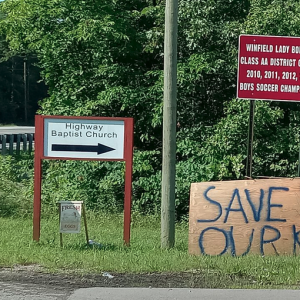
A multitude of signs have sprang up across Scott County protesting the proposed Roberta II landfill and the rail transfer station that would sit near Winfield Elementary. Local residents fear the potential repercussions from each, especially with its proximity to Scott County’s students, and have rejected the proposal since it was made public in May 2025. Concerns over stalled cars that odors in communities, they say, could not only impact public health, but local businesses and the growing tourism industry.
While complaints were initially ignored, eventually representatives from Norfolk Southern, the Environmental Protection Agency (EPA), and Domermuth Environmental Services investigated the situation and determined the waste was non-hazardous, despite its odor. The material was then removed and transported to Domermuth in Stearns, Kentucky, along the old K&T Railway tracks near McCreary County’s tourism hub at Historic Stearns and Big South Fork Scenic Railway, where Domermuth has long operated a waste processing and disposal facility in McCreary County, which reportedly handles industrial sludge, contaminated soils, wastewater residuals, and other non-hazardous waste materials, via a contract with a local company.
Even without haunting concerns over Roberta II or Domermuth, the Pine Knot incident reignited local anxieties about rail-shipped waste, originating miles and even states away, sitting idle in local communities – a scenario that has been likened to other occurrences where Southern Appalachia has been seemingly abused by outside influences. Those concerns mimic what happened in Parrish, Alabama, in 2018, when railcars loaded with human sewage sludge from New York City sat stranded for months near homes and youth little league fields. Not unlike Pine Knot, Alabama residents described the smell as “rotting corpses” and “death.” As a result, the so-called “Poop Train” became a national symbol of rural Southern communities being used as dumping grounds for out-of-state waste, making local fears seem a reality.
Critics of the Roberta II proposal see that possibility, too, fearing that history could repeat itself in Scott and McCreary Counties. With Norfolk Southern rail lines already running through the area, opponents worry that stalled railcars carrying waste bound for Roberta could leave local communities dealing with more than just a landfill, but foul odors, insects, large birds, and environmental concerns that could damage local business and the growing tourism industry, staples to the local economy, all the while outside corporations profit.
As discussed recently at a Cumberland Clear meeting, for many residents, the question is no longer whether such a situation is possible, but how the region can work together to stop the project from becoming a Parrish, Alabama.