ACLU, Democrat lawsuits accuse Redistricting of Racial Gerrymandering
PROTECTED CONTENT
If you’re a current subscriber, log in below. If you would like to subscribe, please click the subscribe tab above.
Username and Password Help
Please enter your email and we will send you a password reset link.
ACLU, Democrat lawsuits accuse Redistricting of Racial Gerrymandering
By Shane Gilreath
SCN Contributing Editor
[email protected]
Multiple lawsuits have been filed challenging Tennessee’s controversial new congressional maps, a case that could not only reshape the state’s elections but align the state at the forefront of a nationwide debate over voting rights and partisan redistricting.
One lawsuit was filed by the Tennessee Democratic Party, who has adamantly opposed the new mapping, along with plaintiffs that include congressional candidates Chaz Molder and Chaney Mosley, as well as several Tennessee voters. A separate lawsuit was filed by the American Civil Liberties Union (ACLU) on behalf of Memphis voters, arguing the new maps violate the 14th and 15th Amendments by intentionally discriminating against black voters and retaliating against rights of political expression under the Freedom of Speech. While the latest filings came from the League of Women Voters of Tennessee and the NAACP, who call the districting ‘racially discriminatory.”
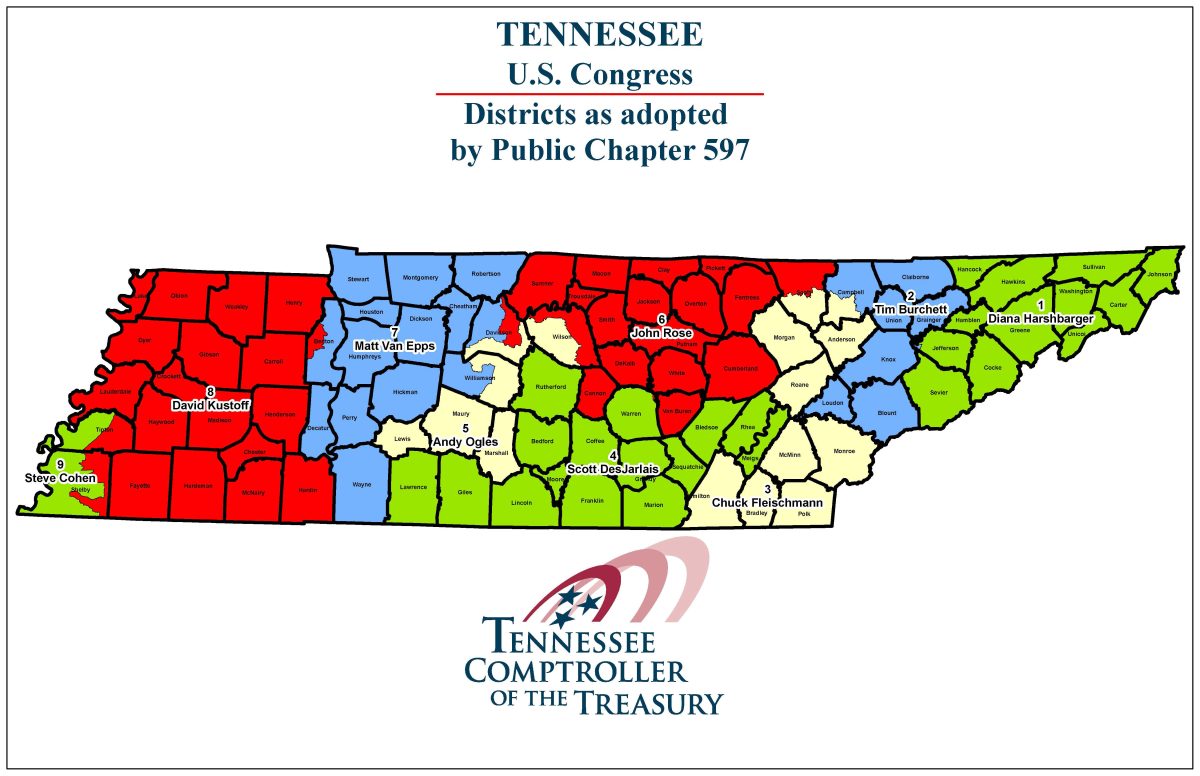
At the center of the suits remains the dismantling of a black majority district that centers around Memphis and Shelby County. Under the new map – which was approved by the Republican controlled super majority in the state legislature – Shelby County is split into three separate congressional districts, dispersing Memphis voters – in a city that is majority black – into surrounding Republican-leaning areas.
Critics of the Republican led vote suggest the move was designed to eliminate Tennessee’s only Democratic congressional district and lessen the influence of the African American vote. Republicans have largely defended the map as an effort to better reflect the state’s conservative electorate.
Despite a push from Democrats, U.S. Chief District Court Judge William Campbell, Jr. for the Middle District of Tennessee denied a Temporary Restraining Order (TRO) sought by the Tennessee Democratic Party, along with other plaintiffs, to halt the new maps taking effect ahead of last Friday’s candidate qualifying deadline. The Campbell ruling is a procedural threshold decision, not a finding on the merits of the underlying lawsuit. The judge has not yet issued a written memo explaining his reasoning. The lawsuit, which challenges the legality of the map, however, will continue. Other active legal challenges to the maps are also pending.
“We are disappointed in the Court’s ruling,” said Luis Mata, Deputy Executive Director of Tennessee Democrats. “But one procedural decision does not change what these maps are: racist, reckless, and wrong. Rewriting the rules mid-game is a disgrace, and we are not going to let them get away with it. The fight continues in the courts, at every ballot box, and in every community these maps were drawn to silence. We are organizing in every corner of this state and we are not backing down. They can split the district lines, but they cannot split the power of the people.”
The push for redistricting was intensified after a recent US Supreme Court ruling on the Voting Rights Act. Following that decision, President Donald Trump publicly urged Tennessee leaders to redraw congressional lines to give Republicans an additional seat in Congress. Reports indicate Trump spoke directly with Governor Bill Lee about convening a special legislative session for that purpose.
US Senator Marsha Blackburn, herself a Republican frontrunner for governor, became a public advocate for redistricting by encouraging that special session that remapped Tennessee with a “9-0” Republican congressional stronghold – to help, Blackburn said, “cement President Trump’s agenda.” Blackburn’s words came just days after the Supreme Court’s 6-3 decision in Louisiana v. United States, which struck down a black majority congressional district in Louisiana for relying too heavily on race under Section 2 of the Voting Rights Act – an issue that remains central to the argument. While other states have taken up redistricting, others, like South Carolina, have, as of press, declined the president’s request to take up the issue.
SCN will continue to monitor this story.