
Scott County Historical Society
PROTECTED CONTENT
If you’re a current subscriber, log in below. If you would like to subscribe, please click the subscribe tab above.
Username and Password Help
Please enter your email and we will send you a password reset link.
A History of the New River Lumber Company
(NOTE; The following article was taken from the December 16, 1987 Observer News, Clinton, Tennessee,
and was written by Oscar Phillips.)
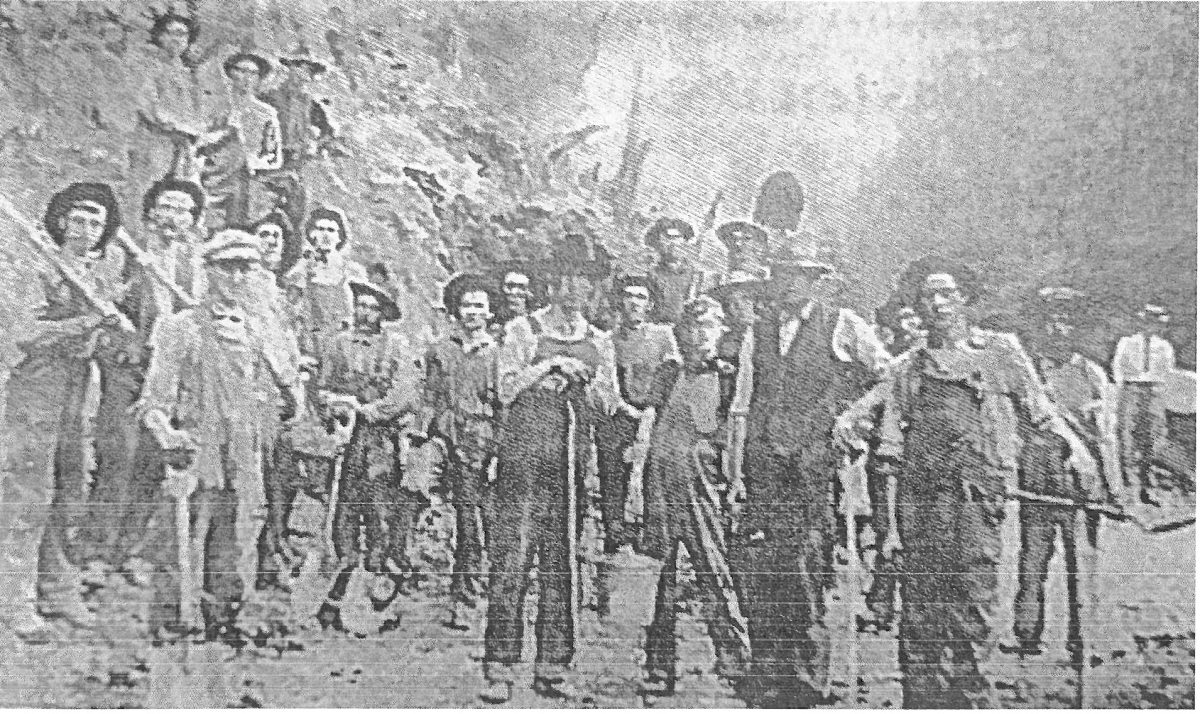
THE OPENING OF THE NEW RIVER VALLEY, This old photograph, taken in 1913, shown the crews excavating for the railroad which opened in the New River area to rail transportation and initiated the lumber and coal boom in that area. The railroad was cut from Anderson County to Beech Fork and on to Smokey Junction in Scott County to link up with the Tennessee Railroad into Scott County (later purchased by Southern). The men in this photo are mainly local folks and we have managed to identify most of them. From left to right; Byrd Phillips (with pick); Reverend Ike Phillips; Mr. Ward (with shovel); Jim Reynolds; Arnie Nolan, Calloway Byrge, Charlie “Dutch” Bunch, Maynard Bunch, Lee Ward, Kelly Nolan, Doc Agee Patterson (with water bucket, Ransey Phillips; the man with a pope is a Ward; center rear holding tools above heads are Nicky Patterson and Houck Daugherty; three to right of man with pope are Chuck Patterson, Mr. Nolan, and Ferdin Davis, Up on the hill to the left are Jim Davis, a Bunch and a Ward, while the dandy in straw hat and tie at far right was one of the bosses.
In 1918, Southern Lumber Company of Nashville owned a Band and Barrell Stave Mill at Nicks Creek, Tennessee. Mr. Mackelane was superintendent. The mill was later moved to Montgomery, Tennessee, between Smokey Junction and Norma.
Andrew and Nat Gennett from North Carolina bought out Southern Lumber Company’s timber and milling operations at Montgomery. The Gennetts also had a Bandmill on Smokey Creek, and a Circlemill at Bull Creek. Bill Berry was superintendent at the Montgomery Mill. His son Charley Berry was the bookkeeper. Two other sons were employees. Other employees were Earl Washam, Sherman Phillips, Doffes Wright, Fred Hembree, Wiley Carroll, Bob Daugherty, Isaac Duncan, and Fielden Newport. John Finley moved his family from a town near Crossville to work at Nicks Creek, Montgomery, and later to Gennett’s camp below Clinchmore, Tennessee.
When Blue Ridge Lumber Company ceased operations at what was later to be Clinchmore, the home of Clinch more Mining Company, Andrew and Nat Gennett bought its mills. Extensive repairs were made on the lower mill at Gennett’s Camp. Small gauge steel was laid from the mill through Round Rock, through Long Bottom and to the head of Roung Rock Creek. Steel was also laid up to the head of David’s Creek which is the left tributary of Round Rock Creek. Mart Newport was section foreman, in charge of laying steel, building log bridges, maintaining the railroad bed. Steel was also laid up the Billy Tackett Branch to a point where logs were brought down the mountain on wire cables. The company owned a large steam railroad engine and a smaller engine which was used to pull the logging flat cars up and down the steep grades. A small T-Model Ford truck with rail wheels was used to haul supplies.
Gennett’s Camp consisted of several green lumber houses built by Richard Newport. The company issued scrip bearing its name, which could be spent at the commissary. Virgil Murley was store manager at that time. Ice was shipped in by rail, and stored in a small building which had a thick sawdust door and walls. Joe Cross was the superintendent and also ran the boarding house mail was delivered by Roy Asbury, who rode through the mountains on horseback. Doc Hatfield provided for the Camp’s medical needs, and Jessie Cook had his own barber shop. Many of the company’s employees at the Montgomery Mill followed it to its new location below Clinchmore.
The names of some of the other employees are: John Stone, Lester Finley, Earl Washam, Charlie Phillips, Hus Marcum, Ed Younce, Homer Warren, Harley Steward, Parnick Byrd, Tom Gibson, Jap Butler Jake Kennedy, Bart Marlow, Powell Marlow, Roy Jones, Levi Anderson, Gurley Young, Jess Hamon, Aaron Phillips, Johnny Wilson, and Jessie McKamey.
Gennett Lumber Company shut down its mill at the beginning of the Depression. In the late 1930’s, the mill, shop equipment, and two railroad engines were pounded into scrap.
Other timber and milling operations provided employment for New River residents. Blue Ridge Lumber Company logged in the head of Stoney Creek. It sold out to Gennett Lumber Company. Ralph Welch was a contractor who cut timber and operated a bandmill for Davison Lumber Company. The site of the operation was between Clinchmore and Beechfork (Shea, Tennessee), and today is known as Welch’s Camp.
The Shea brothers were contract timber cutters for several years for the New River Lumber Company which at one time had control over 60,000 acres of timber. Shea, Tennessee (Beechfork) was named for the Shea brothers. They cut and logged timber for Beechfork Timber Company which was owned by M.C. Bricker of Chicago, Illinois. Beechfork Timber Company’s assets were acquired by Andrew and Nat Gennett. The Shea brothers were also contract operators of the band mill at Blue Ridge Lumber Company. Ide Thompson and his, Buster, logged and owned a mill at Elijah’s fork (Stainville, Tennessee).
The New River Lumber Industry could not have existed without a railroad, even though some timber had been previously cut and floated for miles in long rafts down the river to the nearest mill. Jack Seiber remembers seeing the last raft of logs floating down the river. He said that a rooster was on the raft, crowing vigorously, and also aboard and playing a banjo. The railroad originated in Scott County, near Oneida, and was extended very slowly over a period of several years into the New River section of Campbell and Anderson counties. It reached Beechfork in 1912. Lucien Byrd was one individual who played a very important part in the New River Lumber Industry. He came from Penfield, Pennsylvania in 1884 to look after the interests of persons who had invested in the land and timber in Scott, Campbell, and Anderson Counties. For several years, into the early 1900’s, his name appeared on all the old deeds and county tax records as if he were the sole owner. The bulk of the holdings were later sold to the New River Lumber Company at Norma.
Many persons born since 1900 remember “L.” Bird. He seldom used his first name. It is said that he often traded a rifle for a tract of land. He would travel over the walking paths and sled roads of the mountains, and would stay all night with different people.