Trash Talk
PROTECTED CONTENT
If you’re a current subscriber, log in below. If you would like to subscribe, please click the subscribe tab above.
Username and Password Help
Please enter your email and we will send you a password reset link.
Trash Talk
Mayor Phillips-Jones hosts Public Forum to address controversial Landfill issue

Photos by Shane Gilreath
Concerned citizens continued to blast plans for a new landfill and transfer station in Winfield at a public forum hosted by Oneida Mayor Lori Phillips-Jones and the Town of Oneida. At the close of the event, Phillips-Jones spoke with constituents and addressed written questions from Oneida businessman Scott McNamara, left, who has proven a leader in the local opposition to the project. McNamara is the administrator of the “Don’t Trash Scott County, TN” Facebook page, which has generated over 1.5K followers.
By Shane Gilreath
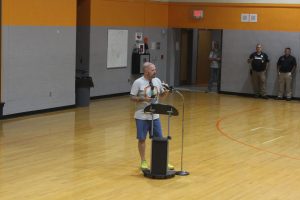 While the June 2nd County Commission meeting adopting Jackson Law was sparsely attended, the Oneida Public Forum was not, as residents amassed to address the burgeoning threat of a landfill and transfer station. Before hearing from constituents and residents of both Scott County and McCreary County, Kentucky, Oneida Mayor Lori Phillips-Jones told SCN that the municipality is within its rights to adopt the Tennessee statute popularly called Jackson Law, an issue that has been placed on the agenda of the next Mayor and Alderman meeting on June 26th, a measure that she views as “another pair of eyes.” The sentiments of those in attendance, however, seemed divided. Some placed their hope in the Scott County Commission. Others were squarely in the Oneida camp, as they begged the Mayor and Aldermen for help, while more yet seemed to turn their attentions to Winfield, whose board will meet Tuesday afternoon at 1pm, in their pleas to stop what most overwhelmingly see as the ultimate debasement of the
 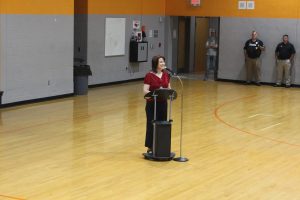 community they love. The questioning of that love left Phillips-Jones emotional on Thursday, as she addressed a list of concerns presented to her by Scott McNamara, who has been an outspoken critic of the landfill proposal, and one of dozen citizen to address the forum.
“For those of you who know me,” Phillips-Jones said, while visibly fighting back tears, “I can’t believe you would ask this question. I have grown up here and returned here to raise my family, because I love this community. I did not run for mayor for a job. I ran to make a change to better our community. To date, my administration has brought in over $2,000,000 in grants to improve Oneida. And that’s just in a year-and-a-half. The health and safety of our residents is the utmost importance to me and my aldermen. So, don’t ever doubt that.”
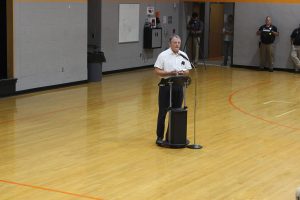 While the Mayor’s name and those of extended family have plunged her into the debate, Phillips-Jones sought early in the forum to address the matter, later saying that she had met with Knox Horner, the man who has been the public face of the controversial proposal, because, she said, that’s her job as Mayor of Oneida. But at one point, Phillips-Jones, who has served as Oneida’s 21st Mayor since 2023, went a step further in disassociating with the contentious project. “I want to personally make it clear that I have no business connection whatsoever to Knox Horner or Roberta Landfill. Period,” she said in her opening remarks. “The Oneida Mayor and Aldermen have never expressed their support for this project in any manner,” she went on to say, “and it has never been on an agenda for our regular meetings.”
The gravitas of the meeting was spurred when Horner, the Cleveland, Tennessee, native, who seeks to bring his waste enterprise into Scott County seemed to shift his initial plans for a transfer station at the end of Main Street to a new location: Winfield. The plan was further consolidated when it became apparent that Trans-Rail Waste Services, LLC, which formed on May 30th of this year, and for which Knox Horner is listed as manager, had filed for permission to locate a landfill transfer station on Poplar Lane, located near Winfield Elementary, an issue that brought Bill Hall, Director of Scott County Schools, to the forum. Paperwork for that filing suggest the site could process 1,500 tons of waste per day, a weight that is comparable to that of a locomotive engine.
“I have been a teacher, a coach, assistant principal, principal, and director of schools,” Hall said, calling the landfill issue an important topic for citizens and Scott County. “I didn’t know until I heard people talking, the issue that’s in front of us.” Hall said he had gotten an email informing him that trash would be placed 300 feet from Winfield Elementary. “As an educator,” Hall told the Mayor and Aldermen, “kids have been my passion. As a father, kids are my passion. I see nothing good that can come of this, wherever it’s placed.”
Hall’s sentiment is one shared by many across Scott County and was supported by school district employees at the forum.
“To put this in their front door is appalling,” Hall said, of one of the district’s largest schools, serving approximately 200 students, “It is degrading and it is beyond something that we, as Scott Countians, can sit still for. It touches a lot of lives,” Hall went on to say. “Let’s get it stopped. Let’s get it stopped now.”
“These children need an advocate,” Hall affirmed. “I will be their advocate and I know I’ve got my back covered.”
Hall led a long list of speakers, who registered with City Hall ahead of Thursday’s forum. That list included Ralph Trieschmann, Kenneth Newport, Micah Phillips, Cheyanne Leonardo, Stephen Phillips, James Stewart, Kathy Obrusanszki, Ella Mullis, Fred Dann, Sheena King, John King, and Scott McNamara.
Trieschmann, who said he spoke on behalf of Timber Rock Lodge and as Chair of the Industrial Development Board and a member of the Scott County Chamber of Commerce, called on local government to act “on need and not greed.” The business owner listed a multitude of ways the proposal could negatively impact his business, citing a damage to the growing tourism industry and roadways, admitting that he was “deeply concerned.”
“It’s about the identity of Oneida,” Trieschmann said, “and the vision for our future.”
Like Hall, Micah Hughett Phillips approached the issue as an educator and a parent, recalling the days when Scott County students were taught the slogan, ‘Great Scott, Keep it Clean.’
“Does anyone remember that slogan?” Phillips asked to a show of hands. “As a child in school, the county government taught the children of Scott County to keep our county clean under the ‘Great Scott, Keep It Clean’ initiative. We were taught to protect our environment. We were taught to not litter. We were taught about the negative impact the trash can have on our environment. The kids that the Scott County government taught about keeping our beautiful county clean are grow up now,” Phillips said. “And we listened. We are here.”
In producing her argument, Phillips cited EPA studies that suggest Scott County waters are already polluted. “My point is,” Phillips said, “our water is already contaminated. Can you imagine what another landfill with hazardous material being hauled in from other areas could do to our health? I’ll say it again: our children deserve better than this.”
Phillips was followed to the podium by an impassioned Cheyanne Leonardo. The local writer and artist, who said she drew endless inspiration from the beauty of Big South Fork, has been a visible adversary of the landfill project since the community found out, via social media, ahead of the May County Commission meeting. Leonardo opened her address with a well-known piece of scripture, “thou shalt love thy neighbor as thyself,” before asking “what does it mean to love thy neighbor?”
As the audience sat in contemplation, Leonardo continued. “We have a responsibility to see how our actions affect others,” she said, urging citizens to fight for the “vitality and integrity of the community,” saying Scott County deserves better than to be used as “a rich man’s dumping ground.”
“We will not be collateral damage in someone else’s success story,” Leonardo proclaimed. “Do not sign away our lives,” Leonardo pleaded, before closing with a fervent poem.
Stephen Phillips followed with an equally passionate cry: “This will continue until it’s not allowed to continue anymore,” he said.
“Wherever the springs run, wherever the rivers run, wherever it goes, that’s where the poisons go,” James Stewart told a partially filled OHS gymnasium, painting a picture of the disaster that befell his family’s hometown in Texas. “Think of all the lives it could affect, “ he urged. “There’s no way you can put a dollar sign on those kinds of affects.”
Kathy Obrusanszki came next. Obrusanszki, a respected teacher, has found herself a leader among those opposing the landfill, her thorough research on the subject even recognized by Phillips-Jones. Hers was an informed appeal, articulating the beauty of the area, painting a portrait that opponents charge will be subject to devastation given any additional waste expansion.
“I’m overwhelmed by the beauty of the place,” Obrusankzski said. “The smell. The river.” Hers was a portrait that many had painted, delicately drawing on the natural senses in stalwart resistance. “The biggest issue they have in their arsenal is secrecy,” she said. “That we have to continue in this peasant mentality.”
But it wasn’t all fun and games, nor the beauty of a tourism pamphlet. This issue cannot solely be.
“This is making the entirety of the tracks that go through out county a dump,” Obrusanszki said, citing the multitude of items that fall within the state’s Special Waste Class I categorization. By Tennessee law, such a classification is given to solid wastes that are difficult or dangerous to manage. These may include sludge, bulky wastes, pesticide wastes, medical wastes, industrial wastes, hazardous wastes, liquid wastes, friable asbestos wastes, and combustion wastes.
“It doesn’t take long for all that trash to be on the playground (of Winfield Elementary),” she said, urging the Oneida Mayor and Aldermen to renew Jackson Law. “It doesn’t stop 24-acres of Roberta II,” she said, citing the oft-associated landfill project, “but can stop them from expanding that footprint.”
The landfill is on Oneida land, Obrusanszki told attendees, acknowledging the January 1992 vote by Oneida government to annex 1,065 acres of land in the Bear Creek area. At the time, opposition was, largely expressed by Winfield residents who opposed the creation of the landfill. Obrusanszki’s charge ostensibly laid responsibility to act on the Town of Oneida. “I would ask that you guys help Winfield,” she urged the Mayor and Aldermen. “Work together with them and also create your own overlay.”
“We needn’t think that Knox Horner is going to grow a heart and not have the transfer station 300 feet from Winfield School,” Obrusanszki said. “That’s not going to happen.”
Local business owner, Ella Mullis, took the lectern after having a dramatic show down at the County Commission meeting on May 25, 2025. “We’re not a trash dump,” she emphasized. “This is one of the most beautiful places in the state.”
For many, Mullis was credited with identifying Knox Horner during that Commission meeting, as the Cleveland, native sat listening to the community objections.
“The people that live in this county are salt of the earth people,” Mullis said. “And you don’t get that anywhere else.”
While the beauty of the area reigned supreme for some, the potential dangers were another.
“When it gets in the water, it gets into you,” said Fred Dann, who urged attendees to google “problems with landfills.” According to the UK-based Green Match, some of those results include environmental risks, groundwater contamination, air pollution, impacts on biodiversity, and a disproportionate societal impact, given minority and low-income areas are more likely to host landfills and hazardous waste sites, a particular charge the next speaker latched onto.
McCreary County residents Sheena and John King addressed the Oneida Mayor and Aldermen, calling themselves downstream from the potential hazards. “Our home is under threat,” Sheena said. “Once again, outside investors are descending upon Appalachia, waving promises of economic growth, while disregarding the devastating toll their actions will have on our land and our residents. Far too long, our region has been exploited by corporations that claim to bring prosperity, only to leave behind pollution, destruction, and communities struggling to recover.”
“The people have spoken,” Sheena concluded. “We have made it clear that we oppose the landfill and we demand protection for our families for generations to come. We deserve better.”
“You have the responsibility to represent and carry out the will of the people. The people have spoken and are speaking. The choice could not be more clear,” John professed. “In life,” he said, “ we get very few chances to be a hero – maybe one of two chances in life – and this is one of them,” he told government officials. “I ask that you keep that in mind.”
Heroics were what many hoped for, but the event was not without passionate and effective pleas. One of those came from McNamara, a Scott County transplant and co-owner of Gather Coffee.
“I’d like to start out by giving some credit to Mr. Horner,” McNamara said. “He brought up a very valid point in the county meeting. And that point was around all the new jobs that this can bring to the county. I don’t think we should disregard that. Think of all the chemotherapy specialists, the realtors selling our homes, liquidation companies who close businesses, evacuation drivers, respiratory therapists, and firefighters trained in chemical fires.”
McNamara’s remarks drew applause from attendees.
“This is not time for meekness or timidness,” McNamara said, turning his attention to government officials. “This is not time to fear legal investments or lawyer bills. If we need to meet fire with fire, we should at least put up a defense.”
Phillips-Jones closed the forum by addressing McNamara’s submitted questions, in the process reminding citizens that the holder of landfill permit had done so since 2010, subsequently the year the county’s Jackson Law resolution expired.
“We welcome your continued involvement,” the mayor said.