TCAT cosmetology student overcomes physical limitations to reach her goals
PROTECTED CONTENT
If you’re a current subscriber, log in below. If you would like to subscribe, please click the subscribe tab above.
Username and Password Help
Please enter your email and we will send you a password reset link.
TCAT cosmetology student overcomes physical limitations to reach her goals
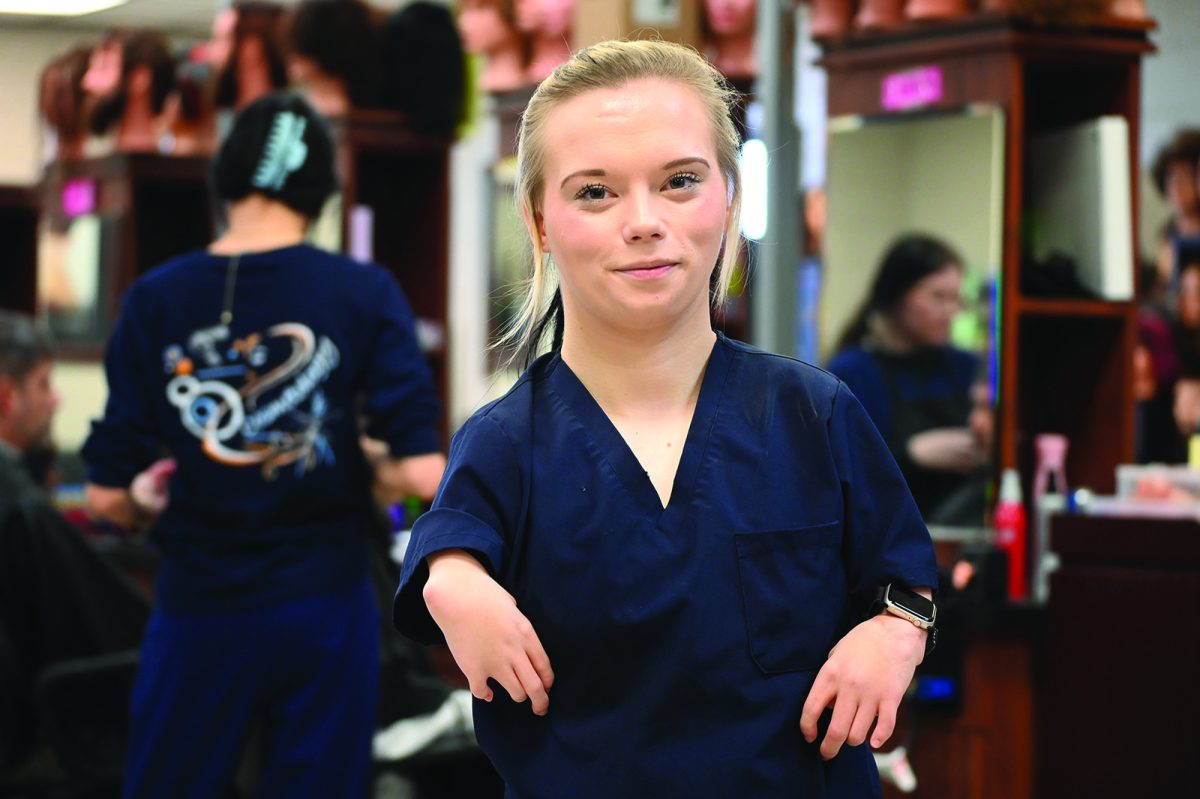
Chyenne King suffers from TARs but refuses to let the congenital condition define her limits
HUNTSVILLE — Chyenne King has never been one to let obstacles stand in her way.
Born with Thrombocytopenia-absent radius syndrome (TARs), King has lived her entire life with a physical disability that might prove debilitating for some, but she refuses to let it define her — or stand in the way of what she hopes to accomplish.
As a result, the 22-year-old King is four months into the Cosmetology program at Tennessee College of Applied Technology Oneida/Huntsville. If all goes according to plan, she’ll be a licensed cosmetologist in about April 2026.
TARs, which affects as few as one in every 200,000 newborns, is characterized by a platelet deficiency and an absence of the radius bone in each forearm.
To those who aren’t familiar with TARs, the most obvious outward symptom is the missing radius bones in the arms. But the most serious symptom of the rare condition is actually the lack of normal blood clotting. It can cause severe, life-threatening hemorrhaging in babies, though it tends to become less severe with age.
King, who is also missing half of her left shoulder, some bones in her fingers, and the humerus bone in her right arm, spent the first year of her life at East Tennessee Children’s Hospital in Knoxville.
Later, after she learned to walk, the surgeries started.
“I was bow-legged, and I would walk pigeon-toed,” she said. “They tried casts and stuff, but it never worked.”
King underwent surgery for the first time when she was just three.
“Little did my family know this surgery opened the doors to having many more surgeries as my legs just kept going back bow-legged,” she said.
By the time she was 15, King had undergone 17 surgeries. The Shriners Hospital for Children had become a second home.
“Every year, like clockwork in school, I was going through surgeries,” she said. “It always fell right before my birthday.”
At one point, at around age eight, King had to leave school after undergoing a knee reconstruction surgery that required a cast up to her hip. She went on a homebound school schedule.
“That really bummed me out,” she said. “I really did like school as a kid.”
Even as a child, King refused to be defined by disability. She eventually graduated from Scott High School in 2020, the Covid-19 year that resulted in a complete disruption for high school seniors. After high school, she worked at McDonald’s in Oneida for two years. It was a challenge, she said, but not an impossibility.
“When I went into the interview, I told them my concerns,” she said. “I was like, ‘I do have a disability, but I do want to work, and I am a hard worker and I show up every day.’”
One thing King was clear about: “I don’t want you to cater to me; I just want you to accommodate me,” she told her employer.
“I was raised with the attitude that nothing is just given to you,” she said. “You don’t get it handed to you; you have to work for it. You have to put forth some sort of effort or it’s not even worth anything.”
That was a message instilled at a young age by King’s parents, Jessica King and Joey Hammock. She also credits her grandfather, William Patterson, with being a major influence in her life.
These days, King has two children — a three-year-old and a two-year-old — and she doesn’t hesitate to say that it’s her kids who drove her to go back to school.
“I want my kids to have someone to look up to,” she said. “I’ll be the first in my family to have a degree. I want my kids to say, ‘Okay, Mommy went to school, and I can do it, too. She had us when we were two and three and she went to school and did all this, and I want to do that, too.’”
Once she made the decision to further her education, King quickly settled on becoming a cosmetologist.
“I’ve always had a passion about hair, nails and makeup,” she said. “I’ve done makeup since I was 14 years old. I’ve always done my own hair. And I fell in love with the idea of coloring hair and making clients happy with shocking results.”
Initially, King didn’t know if she would be accepted into the program.
“When I got the acceptance letter, I was like, ‘Oh this is real; I’m actually going back to school!” she said.
King will be the first to tell you that there are challenges involved with being affected by TARs and being a cosmetologist. But she also says it isn’t something that has to define you.
“The struggle is with reaching,” she said. “With a 180 (degree) haircut, you have to pull the hair up. And if they have long hair, that’s a challenge, because I can only pull up so far.”
Working with her instructor, Jayne Roysden, King has found ways to overcome that limitation.
“We have found ways to still do the 180 and not chop the hair off,” she said. “Jayne has been amazing. When I was looking at coming back to school, one thing I was looking for was to have a teacher who was not only passionate about her job but was also accepting of me.
“I didn’t want a teacher who was like, ‘Oh, you probably can’t do that,’” King added. “I wanted a teacher who would say, ‘Let’s see what we can do about that. Let’s find different ways. Let’s think of different ways.’ Jayne has helped me brainstorm more than I could have imagined.”
“Chyenne is an excellent example of a person who despite her physical challenges rises above and beyond her limitations,” Roysden said. “She is always eager to learn and a delight to be around. Together we have overcome some major obstacles. I truly believe with her determination and perseverance she can do most anything she sets her mind to do.”
To others with disabilities who might fear the prospect of furthering their education because of their condition, King’s message is, “Don’t think about how ‘This is going to get in my way,’ or ‘I can’t do it because of this.’ Just do it. Because that’s what I did.”
For more information about TCAT Oneida/Huntsville and the programs offered by the school, call (423) 663-4900 or visit tcatoneida.edu.