Landfill Proponent challenges Cumberland Clear
PROTECTED CONTENT
If you’re a current subscriber, log in below. If you would like to subscribe, please click the subscribe tab above.
Username and Password Help
Please enter your email and we will send you a password reset link.
Landfill Proponent challenges Cumberland Clear

Photo by Shane Gilreath
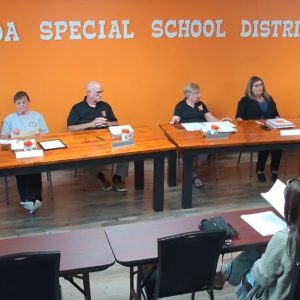
Rhonda and Rick Shelton (seen here with Cumberland Clear Executive Committee member Kathy Obrusanszki), who live near the proposed second landfill, have long been vocal opponents of the project, appearing at public meetings to express their misgivings. Both expressed their concerns during last week’s Cumberland Clear meeting at Timber Rock Lodge.
By Shane Gilreath
SCN Contributing Editor
[email protected]
A routine meeting of the citizen group Cumberland Clear took an unexpected turn last week when an unannounced guest appeared: Will Goff, Vice President of Ackerman & Company, the Atlanta-based firm closely tied to the controversial Roberta II landfill proposal in Scott County. According to the company’s website, Goff specializes in land brokerage and site selection for clients, work that has placed him at the center of the Roberta II dispute. His presence surprised even the meeting’s organizers, but it ultimately led to a lengthy exchange with Cumberland Clear members about the future of the proposed landfill and its potential impact on the surrounding community.
The discussion quickly turned to environmental and health concerns long raised by opponents of the project. Addressing those questions, Goff defended the landfill’s design.
“This is a lined landfill,” he said. “It’s got a big thick vinyl liner on top of the clay.”
Goff’s assessment was not entirely without merit. Modern landfills often rely on synthetic liners – typically plastic or, as Goff attested, vinyl membranes paired with compacted clay – to contain waste and prevent contaminated liquid, known as leachate, from entering surrounding soil and groundwater. But environmental researchers and regulators have also long noted that such liners are not fail-proof. Despite Goff’s defense of the product, tears, punctures during installation, chemical permeation, or long-term degradation can allow contaminants to escape over time. Some cases have shown that waste placement itself can damage liners, including the Chemical Waste Management hazardous waste landfill near New Haven, Indiana, where 83 holes were punched in the protective liner during early operations, requiring the waste to be removed so the liner could be repaired.
Failures or weaknesses in landfill containment systems have also caused regulatory concern elsewhere. In New York, state inspectors once cited problems with the protective liner system at Dunn Construction and Demolition Landfill in Rensselaer, warning that flaws in the material designed to contain leaks could allow contaminated water to escape into surrounding soil if not corrected.
Cumberland Clear, Kathy Obrusanszki challenged Goff’s reassurance, pointing to the fact that regulators have not approved the project’s current plans. She argued that if the landfill’s proposed design – including a controversial French drain system – met environmental standards, the Tennessee Department of Environment and Conservation (TDEC) would have already allowed the permit process to move forward.
Citizen Rhonda Shelton echoed that skepticism. “TDEC has guidelines on establishing landfills and everything you’re doing goes against those guidelines,” Shelton, a former educator, who told Goff that her property valued had already diminished, said.
Like other proponents of the project, Goff emphasized potential economic benefits, describing the landfill as a job creator for Scott County. He also cited a 1992 court ruling that developers argue exempts Roberta II from the state’s Jackson Law restrictions on landfill siting.
Obrusanszki disputed that interpretation, as has Cumberland Clear’s lawyer Elizabeth Murphy, saying official records show the ruling applied only to the nearby Volunteer landfill.
In August, Murphy said that TDEC began the review of the project in direct violation of state law, given it is “undisputed,” according to Murphy, that Scott County adopted Jackson Law in 1989. A law firm representing Volunteer Regional also notified TDEC in 2009 – seven months before the 2010 permit was issued – that a 1992 court ruling applied only to Volunteer Regional and not Roberta II
“I guess that will be determined in court,” Goff replied.
Despite the respectful disagreements, Goff said he attended simply to hear concerns firsthand. The meeting also featured a preview of a forthcoming documentary project, “Voices Upstream,” which will highlight the perspectives of residents living closest to the proposed landfill site. Cumberland Clear say the video could be released as early as this week. The organization hopes the production will help relay their concerns beyond Scott and McCreary Counties and garner additional support for their advocacy against the Roberta II project.