Coalition Rolls Forward
PROTECTED CONTENT
If you’re a current subscriber, log in below. If you would like to subscribe, please click the subscribe tab above.
Username and Password Help
Please enter your email and we will send you a password reset link.
Coalition Rolls Forward
Environmental Consultants work on Poplar Lane
By Shane Gilreath
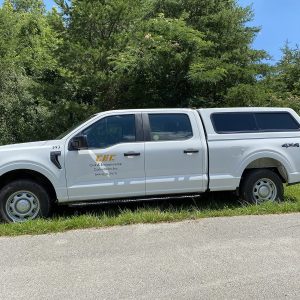
Photo by Jodi Bond
Vehicles from Civil and Environmental Consultants (CEC), who work in sewage, solid and hazardous waste, were spotted in the vicinity of the proposed Winfield landfill on Thursday. According to statements from Knox Horner, the face behind the proposed operation, CEC has been working in the area for 2 years.
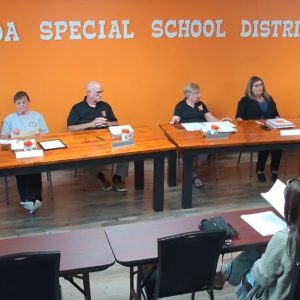
Amid a torrential rain, the Scott County Commission met on June 30th in what became a lightning fast Special Session at the County Office Building in Huntsville. By original design, the meeting was called to pass the 2025-26 County Budget as the Fiscal Year wound to a crescendo, but with continued controversy swirling around a proposed Winfield landfill, most of the attendees – approximately twenty citizens from both Scott and McCreary Counties – were largely gathered in anticipation of one specific item: the proposed coalition of governments. Rumors had flourished over the preceding week about whether the County Commissioners would join Huntsville, Oneida, and McCreary County, Kentucky, but there was no public objection – nor public comment – as the item was brought before the body.
With some Commissioners absent, the resolution to participate in the coalition passed by a 9-0 vote, following a motion by 4th District Commissioner Shonda Gray and seconded by 1st District Commissioner David “Blue” Day, who, as part of discussion, asked what authority the coalition would be granted. Scott County Attorney John Beaty, who has been appointed to represent Scott County on the Coalition alongside Mayor Jerried Jeffers, answered, saying that the type of coalition adopted by the county did not grant formal authority to its representatives, but rather that they ultimately make recommendation to the County Commission. “No action would be taken by anyone,” Beaty said, before explaining that the coalition was trying to coordinate efforts to answer questions. “Any other action,” the attorney confirmed, “would be brought before this body.”
Following unconfirmed social media reports that Knox Horner, who has been the face of the landfill proposition, and his set of investors would be undertaking environmental studies on the proposed site of the landfill and transfer station, Civil and Environmental Consultants (CEC) vehicles were spotted in the vicinity on Thursday. CEC, according to statements from the company’s website, ranks #5 in Solid Waste, #34 in Sewer and Waste, and #49 in Hazardous Waste among the Top 500 Design Firms by Engineering News-Record. As of press, SCN can confirm that the company offers engineering and construction support with traditional and advanced waste management services.
SCN reached out to Horner, as well as Winfield and Scott County government for comment on the origin of CEC’s action. Without identifying the specifics of the undertaking or under whose employee the company was operating, Horner confirmed to SCN that CEC had been working in the area for 2 years.
Following statements made by Horner to Knoxville’s WBIR suggesting that water from the landfill would never leave the site of the Scott County landfill and will not flow northward into McCreary County, Kentucky, SCN again reached out to Horner and, per his request, his legal counsel, Hugh Sharber, at Miller & Martin in Chattanooga, TN. We submitted the following question regarding the possibility of leachate farming, a full-scale bioremediation technology, which usually incorporates liners and other methods to control leaching of contaminants, which requires excavation and placement of contaminated soils, sediments, or sludges. Ideally, this process would prevent contamination from reaching Bear Creek or other waterways that would lead to McCreary County, per Horner’s statement to WBIR.
1. What does Knox Horner, his affiliates, and/or Bearcat plan to do with all of the leachate that all of or part of the 700 acres in landfill would produce? 2. Does Knox Horner, his affiliates, and/or Bearcat plan on using part of or all of the 700 acres to conduct leach farming of the leachate it will be handling? 3. If Knox Horner, his affiliates, and/or Bearcat are planning on leach farming in part of or all of the 700 acres, what precautions are will be undertaken to ensure that no leachate will spill or contaminate Bear Creek or any of the surrounding water tables?
“As counsel,” Sharber responded, “I’m not the right person to address your questions unless specifically requested to do so by my client.” Horner did not formerly respond on-the-record.