
Accounts Of WWII Of Pvt, Jacob Walker US Army Of The 2nd Armored Division Commanded By Gen. Georges. Patton
PROTECTED CONTENT
If you’re a current subscriber, log in below. If you would like to subscribe, please click the subscribe tab above.
Username and Password Help
Please enter your email and we will send you a password reset link.
Accounts Of WWII Of Pvt, Jacob Walker US Army Of The 2nd Armored Division Commanded By Gen. Georges. Patton
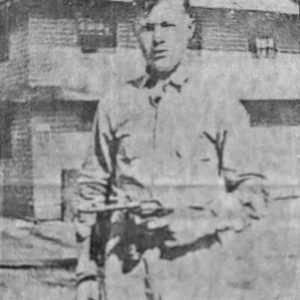
(Article by Don Moore, Sun Correspondent, Punta Gorda, Florida.)
Jacob Walker, of Punta Gorda, Fla. remembers it like it was yesterday joining the service before the second World War more than 70 years ago.
“Seven of us boys were sitting along a creek in the Tennessee hills drinking moonshine. We dared each other to sign up for the Army. All but one of us, except one, we went down and signed up.” the 94 year-old veteran recalled. “We got $21 pay a month as privates. That was a lot of money for a 17 year-old boy.”
Boot camp for Walker was Fort Benning, Georgia. It was August 1941 when he arrived at Benning, less than four months before the Japanese bombed Pearl Harbor, forcing the U.S. into World War II. He was in the 2nd Armored Division commanded by Gen. George S. Patton, who was about to make the cover of “Life” magazine as the U.S. Army’s most notable tank commander. Walker would spend his time during the war as a Sherman tank driver.
What he remembers the most about the colorful general is an inspection Patton held at Benning. Walker was singled out by the general because his rifle didn’t pass inspection. “He would wear white gloves during inspections. He’d take your gun with those white gloves on and if they got grease spots on them you’d had it.” he said “Because of that, I had to dig a 6 by 6 hole, a matchstick was thrown in the hole and then I got to bury it. After all that I got to dig the matchstick back up.”
Shortly after the Pearl Harbor attack, he and his armored unit went to war. “We went to New York City, they put us on a ship and we sailed for North Africa.” Walker said. The first big battle he was involved in took place at Kasserine Pass. It was the first time American and German forces of any size calshed in North Africa. German Gen. Erwin Rommel defeated the U.S. 1st Armored Division in the pass with his Afrika Korps. That’s when Walker and his 2nd Armored Division were thrown into the breach. After the 1st Armored was knocked off we took their place at the Pass. Eventually we won the battle with the help of the British and pushed the Germans back toward the coast,” Walker said. “We chased them all the way to Tunisia. The Germans had big guns mounted on a hill we had to take at Tunis.” After additional fighting by American forces the U.S. troops finally captured the German bunkers and the enemy guns. A short time later, 230,000 German soldiers, with their backs to the sea, surrendered in masse.
Patton and the American 7th Army, of which Walker and the 2nd Armored Division were a part, hopped across the Mediterranean to Sicily. He remembers nothing much about the amphibious landing and invasion of the island. “Operation Husky” is what it was called, it pitted Patton’s 7th Army and British Gen. Bernard Montgomery’s British 8th Army against the German and Italian forces. Both invasion armies moved onto Sicily from the southern shore. The Americans headed west along the coast toward Messina on the North side of the island. The British troops moved north along the eastern shore of the island for the same destination—Messina.
The Allies faced the Axis forces headed by the Hermann Goering Division, the 15th Panzer granadiers and the Italian 6th Army. By early August 1943, a little more than a month after the start of the Allied invasion, American and British armies pushed the German and Italian troops into vacating Messina and escaping to Italy.
Walker remembers very well what happened to him next. He and the rest of the 2nd Armored Division chased after the Germans and wound up penned down on the beach of Anzio, Italy. “The beach of Anzio was a tough place to be,” he said, “We lost a lot of men before we got off that beach.” “Anzio Annie” is the name the Americans gave to the big German cannon at Anzio. It was a 288 mm railroad gun that fired a projectile weighing more than 550 pounds at stranded Allied forces on a regular basis. Walker and the other men in his outfit could see the giant shell fly over just before it struck a target and exploded. German Field Marshal Albert Kesserling had the Allies pinned down on the beach for six months, until June 1944, when Gen. Mark Clark and his American 5th Army broke out of the Anzio beachhead and swung north toward Rome. Gen. Clark was obsessed with having his 5th Army conquer Rome. When he arrived at the gates of Rome with his Army it had been declared an “open city.” Not a gun was to be fired within the confines of “The Eternal City.” So Gen. Clark did not become its conqueror. “When we got to Rome we got a break,” Walker recalled. “We got a couple of days off that gave us time to regroup. We even went to Pompey to see the reclaimed ancient city that had been buried by a volcano centuries ago.”
It wasn’t long after Rome that Walker and his Sherman tank crew were headed north up the Italian boot chasing Germans. “By the time we got to the Alps in Northern Italy, the Germans were losing. They were running out of gas. They left their tanks that were out of gas and ran off.” He said. “We hadn’t gotten out of our Sherman in a week. The sergeant in command or our five-man tank stopped the Sherman and had us take a break,” Walker recalled. “My assistant driver took his helmet off when he got out of the tank, I was sitting down beside him on the tank when a German mortar shell hit a nearby tree and showered us with shrapnel. A piece of the shrapnel went through his head. It killed him right there. After he was killed I got back in the tank and cried. I was scared to death.” he said.
When the war in Europe ended Walker and his tank crew had reached the Black Forest near the Rhine River in Germany, Russian forces were on the east side of the river. He and the other American forces never reached Berlin. The German capitol was captured by Russian troops.
He remembers going back to France to catch a ship for home. The boat arrived at the New York City docks and victory celebrations were still going on,but Walker didn’t see muct, of the revelry. He and his fellow 2nd Armored Division soldiers went to Texas by train where they were discharged. Their war was over.
Eventually Walker got-a job working for Blue Grass Sausage Co. in Covington, Kentucky. After 31 years working as a sausage maker, he retired. He and Betty, his wife of 62 years, came to Florida. The couple have two children, Debbie and Beverly.
Submitted by; Beverly Walker Conover, daughter of Jacob Walker