County Commission Joins the Roberta Fight
PROTECTED CONTENT
If you’re a current subscriber, log in below. If you would like to subscribe, please click the subscribe tab above.
Username and Password Help
Please enter your email and we will send you a password reset link.
County Commission Joins the Roberta Fight

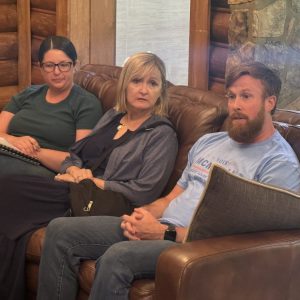
Photo by Shane Gilreath A standing room only crowd turned up for the County Commission meeting last week, many of them were in attendance to encourage commissioners to vote in support of Scott-McCreary Environmental Coalition (SMEC) litigation in the dispute over the Roberta II landfill. Commissioners ultimately voted unanimously on that item.
By Shane Gilreath
SCN Contributing Editor
[email protected]
When the Scott County Commission met last week, momentum had already built within the Scott-McCreary Environmental Coalition (SMEC). Four of its five member governments had already moved to support potential litigation tied to the proposed Roberta II landfill. That left Scott County as the lone holdout with the County government becoming the focal point of both public attention and legal scrutiny.
A standing room only crowd filled the Scott County Office Building, underscoring the weight of the moment. Questions about the county’s position have surfaced not only locally but also in a Nashville Chancery Court, where Rock Properties has challenged the landfill project in court. Attorneys for both the Tennessee Department of Environment and Conservation (TDEC) and Roberta II have repeatedly asked: Where is Scott County? To viewers, their questions went directly to the heart of the county’s public relations problem – where was county leadership on the matter.
Those questions have been fueled in part by a 2010 letter from County Attorney John Beaty, which defense attorneys representing TDEC and Roberta II have claimed shows Scott County’s support of the landfill project. Equally, while the County Commission is represented on SMEC by County Mayor Jerried Jeffers and Beaty, Commissioners have voiced frustration, claiming they were unaware of SMEC actions and had not been informed of goings on.
Ralph Trieschmann, owner of Rock Properties, and thus a plaintiff in the Chancery Court case, addressed the commission directly, urging members to intervene. He argued the county could assert its authority and join the Rock Properties lawsuit, contending that the landfill permit process may have bypassed local approval requirements under Jackson Law and the Scott County Solid Waste Board, an argument that is central to the Trieschmanns’ court case.
With TDEC recently denying Roberta’s Aquatic Resources Alteration Permit (ARAP) and reclassifying the certification process as a major modification rather than a minor one, such arguments of the legality of the permit have weighed heavily on public consciousness. This distinction laid out by TDEC is significant, as a major modification sends the project back to the local approval process, reopening the door for county and municipal input.
Jennifer Shockley President of Cumberland Clear, cautioned the Commission that recent regulatory setbacks put forth by TDEC did not end the landfill fight. Shockley encouraged Commissioners to align with other SMEC members and present a unified stance against Roberta II.
Following discussion, the Scott County Commission voted unanimously to support SMEC’s litigation efforts. While no formal legal action has yet been filed, the decision signals a shift toward regional alignment as the Roberta II dispute continues to unfold across Scott County and neighboring Kentucky.