Beaty Letter Looms Ominously Over Landfill Case
PROTECTED CONTENT
If you’re a current subscriber, log in below. If you would like to subscribe, please click the subscribe tab above.
Username and Password Help
Please enter your email and we will send you a password reset link.
Beaty Letter Looms Ominously Over Landfill Case

Photos by Shane Gilreath
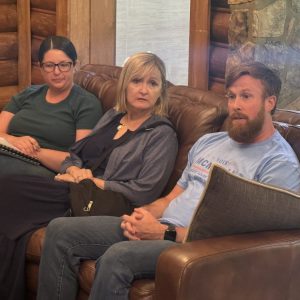
Nashville-based Attorney Elizabeth Murphy, above, who represents Rock Properites in a case against TDEC and Roberta II, spoke with Scott County residents last week after appearing in Chancery Court. A large delegation from Scott and McCreary Counties, below, traveled to the state capital on Friday to support the case against the controversial landfill.
By Shane Gilreath
SCN Contributing Editor
[email protected]
When John Beaty was elected County Attorney in 2002, few would have predicted he would become a controversial figure more than two decades later. After all, he’s generally well thought of in the community, even now, but a letter Beaty wrote to the Tennessee Department of Environment and Conservation (TDEC) in 2010 continues to haunt both the attorney and Roberta landfill opponents. It is among the most controversial – and as of Friday, damning – articles of support for the project, as lawyers for TDEC and Roberta II used the letter to hammer their case that the landfill permit is legitimate, saying the letter is evidence of the County’s support for the Roberta landfill. At least, they contend, in 2010 – the date that matters most to the case. The letter, which Beaty, who now sits on the Scott-McCreary Environmental Coalition (SMEC), has yet to comment on publicly, has been a contentious issue since news of the Roberta II plan broke in May 2025.
Last week, the letter, dominated much of the defense against the Rock Properties suit, despite arguments from Assistant Attorney General Jaime Garcia, who represents TDEC, that the state is protected by sovereign immunity and cannot be sued without waiving that protection. Garcia also contends that Michelle and Ralph Trieschmann, proprietors of Rock Properties, did not reside in Scott County in 2010 when the permit was issued and are therefore ineligible to sue. He reiterated an argument from the previous week – any such petition should have come from Scott County or the Scott County Solid Waste Board (SCSWB). As such, Garcia argued the Trieschmanns have no regressability, i.e., standing to bring the suit.
“The permit is out there,” Garcia said. “It has been issued.”
Garcia’s argument on sovereign immunity rests on a long-established legal doctrine that shields the state from being sued unless it expressly consents. In Tennessee, that protection is embedded in both constitutional and statutory law, and courts have historically interpreted it narrowly in favor of the state. To overcome sovereign immunity, a plaintiff must point to a clear legislative waiver – something explicit, not implied. In the absence of that, even claims alleging procedural errors or improper agency action, which resides here, can be barred before they are heard on their merits. In practical terms, the court must first determine not whether the state acted wrongly, but whether it can be questioned at all.
What unfolded in Chancellor I’Ashea Myles’ courtroom was less a straightforward hearing on immunity, however, than a multi-layered legal battle over authority, timing, and the weight of a single document – one now central to a broader legal and political reckoning. At issue is not simply whether a landfill can move forward, which Scott County has overwhelmingly objected to, but whether the legal foundation supporting its initial permit was sound from the beginning.
Crews Townsend, the Chattanooga-based attorney representing Roberta II, said he was in alignment with Garcia’s stance.
“My client is seeking re-certification of a permit that was issued in 2010,” Townsend told Myles.
That wording – re-certification rather than new approval – became a key element of the defense. If the permit was validly issued in 2010, Townsend argued, then the present effort is procedural, not foundational. That premise, however, is precisely what attorneys for Rock Properties – and organizations such as Cumberland Clear and SMEC – seek to dismantle.
When questioned by Myles on whether permits were issued in perpetuity, Townsend acknowledged that other issues, including water quality concerns, are reconsidered before re-certification. Of the Trieschmanns’ position, he said, “they can’t approve or deny a landfill based on whether they want it or not”.
 To support that argument, Townsend pointed to Beaty’s 2010 letter as both an authentic expression of Scott County’s 2010 support and a valid basis for TDEC’s decision.
“For whatever reason, the plan ended up with (John Beaty) the Scott County Attorney,” Townsend said, suggesting that any aggrievement in 2010 would have rested with Scott County, not the Trieschmanns.
“What we have is a letter that says, ‘as you requested,’” Townsend said. “I guess speaking of (Mike Apple, former head of TDEC’s Solid Waste Division) – it supports (Beaty) has looked at the plan and the application.”
Townsend noted that Beaty wrote the letter on Scott County letterhead, acting in his official capacity, and, according to Townsend, Beaty “finds no inconsistencies” in the Roberta II plan.
It was at this juncture that Elizabeth Murphy, attorney for Rock Properties, visibly picked up the letter from her station as Townsend concluded.
“TDEC relied upon this letter and issued the permit,” he said, arguing it demonstrated that a public hearing and discussion had taken place.
“They didn’t have a hearing,” came a voice from the gallery.
The moment underscored a central tension in the case – whether the Beaty letter represented legitimate county approval or simply served as a substitute for a process that never occurred.
“We don’t have Scott County here making this objection,” Townsend said. “Instead, we have someone trying to protect their property rights.
“It’s too late,” he said. “It’s too late for anyone, but the petitioners didn’t own property in 2010, and they were not aggrieved parties.” Townsend went on to say, “They’re trying to get this court involved not in the end of the process, but during the process.”
“They don’t have standing to object and the time to object here has expired and Scott County is not here making that objection,” Townsend said, making an argument that seemed to muddy the waters of understanding.
Murphy’s response cut directly to the legal core of the case. When she rose, she argued that TDEC lacked the authority to issue the permit at all.
“You can’t have a valid permit,” she said, “because you didn’t get permission to begin with.”
Her argument centers on what she describes as a fundamental failure in 2010. According to filings and supporting documentation, TDEC did not obtain written approval from the SCSWB, a requirement under state law. Instead, the agency relied on the Beaty letter – allegedly written at the request of then–Solid Waste Director Mike Apple, who was later fired by Governor Bill Haslam – as sufficient evidence of local support.
Murphy presented a letter from TDEC to Roberta II stating that the project could not proceed without SCSWB approval. As of press time, no minutes of such a meeting have been found. She argued that TDEC exceeded its legal authority.
“Everything (Crews Townsend) was telling you about (Beaty) having (plans) in front of him,” Murphy told the court, “I don’t care what he had in front of him. He doesn’t matter.”
“There’s no world where Mr. Beaty’s personal opinion counts,” Murphy said, urging Myles to send the issue back to the SCSWB. “But (Roberta II) may not want to go to the (SCSWB), because they don’t think they’ll get the answer they want.”
In the controversial letter, Beaty himself characterized it as a personal assessment – not one derived from formal action by any county body. Despite that, TDEC issued the permit one week later.
Critics argue that sequence of events is more than coincidental, and it is central to the Rock Properties case.
To argue that Scott County was represented, Murphy pointed to roughly 20 residents from Scott and McCreary Counties who traveled to Nashville on Friday, along with SMEC attorney Lisa Helton. Garcia objected to the reference to Helton in the ccourtroom.
Before court was adjourned, the Assistant Attorney General again raised a case for sovereign immunity, beating the issue home. Townsend, in his final remarks before Myles, again defended the Beaty letter – as he did repeatedly throughout the two hours court appearance – rejecting claims that TDEC had misled the public.
“He is the person responsible for advising Scott County,” Townsend said. “If he was deprived, he, on behalf of Scott County, could act…. He never filed any action on behalf of Scott County to say, ‘we were deprived (of a right to object to Roberta II).”’
Townsend added that if Beaty found no inconsistencies in the plan for Scott County, the court should accept that he believed the project was in the county’s interest. “If it wasn’t good for Scott County,” Townsend said, “then Mr. Beaty had every opportunity to do something about it.”
Of the Trieschmanns, Townsend charged, “They’re using Scott County’s rights, when Mr. Beaty didn’t do anything to protect. As citizens of Scott County, Mr Beaty didn’t do anything on their behalf.”
“At this time, there is no role for the court to play,” Townsend said.
For Murphy and other opponents, however, the court’s role is to determine whether the absence of required approvals invalidates the permit entirely. This is not Murphy’s first challenge of the permit to TDEC. In an August letter, she formally asked the agency to revoke the 2010 permit, arguing it lacks legal merit because it was issued without mandatory approvals, including those required under the Jackson Law and by the SCSWB.
“The 2010 Division staff were well aware of what the law required,” Murphy said at the time, “ and that it did not include an opinion of any attorney.”
For residents and environmental advocates, potential impacts on regional waterways have become a rallying point, particularly given the site’s proximity to sensitive areas. It was this that largely built the SMEC body and took the issue across state lines to Kentucky.
SMEC attorney Helton, who briefly spoke with SCN after court, said, “I am here on behalf of the coalition to support the plaintiffs (Rock Properties) in this matter.”
Her presence – the creation of SMEC and the presence of other community members in a Nashville courtroom – would seem to signal that the case extends beyond a dispute between property owners and a landfill operator, reflecting a regional concern.
Ultimately, the question before Myles is both narrow and consequential – whether the petitioners have standing to challenge the permit, whether TDEC has immunity, and whether the permit itself can withstand scrutiny under state law.
For the defense, the case is about timing and procedural finality. For the Trieschmanns, it is about legality and the right to challenge actions that may have bypassed required safeguards.
Myles ultimately asked both parties to submit written briefs on or before May 1, 2026, after which she is expected to rule.
Until then, the fate of the legal case against Roberta – and the legacy of John Beaty’s 2010 letter – remain uncertain, suspended between competing interpretations of law and a growing public challenge.