Candidates Question Election Fairness After Party Removes Names from Ballot
PROTECTED CONTENT
If you’re a current subscriber, log in below. If you would like to subscribe, please click the subscribe tab above.
Username and Password Help
Please enter your email and we will send you a password reset link.
Candidates Question Election Fairness After Party Removes Names from Ballot
By Shane Gilreath
SCN Contributing Editor
[email protected]
The State Republican Party’s recent decision to remove dozens of candidates from the August primary ballot is drawing

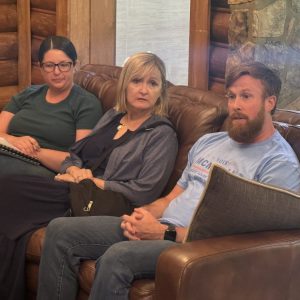
Scott County resident Cody Cox, a Republican who hoped to challenge Rep. Kelly Keisling for State Representative, had already spent time across the 38th District, including speaking to the Pickett County Republican Party, seen above, when his name was abruptly disqualified from the August primary by the state GOP. The party has until Tuesday to reverse that course, but has, as of press, removed upwards of 100 names from the ballot in a controversial move that has drawn headlines across the state.
sharp criticisms from Republicans across the state, including Scott County candidate Cody Cox, who now finds himself disqualified from challenging incumbent State Rep. Kelly Keisling.
Cox, who, while upset, remained hopeful ahead of Tuesday’s deadline, was far from alone. GOP leadership made the decision to remove 40 Republican candidates from the August election, citing a failure to meet the party’s “bona fide” membership requirements – the same “bona fide” claim that allows citizens to vote in what is essentially an open primary. That rule requires candidates to demonstrate active involvement in their selected party, be registered voters, and have participated in at least three of the last four statewide Republican primaries. The party also reserves the authority to disqualify candidates it determines do not meet those standards. Last week’s broad sweeping decision affects candidates across multiple races, including two gubernatorial hopefuls, state Senate contenders, and numerous state House challengers, many of whom, like Cox, who has been an outspoken critic of the Roberta II landfill proposal, were attempting to unseat incumbents.
Despite having submitted the required petitions and signatures to qualify for the ballot, Cox, like dozens of others, was summarily removed following a March 17, 2026, letter from GOP Chairman Scott Golden to election officials across the state.
Cox, a Republican challenger in House District 38, who spoke with SCN on Saturday, expressed frustration and disbelief, a sentiment that carried over into a statement released by his campaign after his appeal to the state was denied.
“Today, I was informed that my appeal was denied – and according to what I’ve been told, it wasn’t even considered,” Cox, who told SCN he has been a lifelong Republican, said, saying officials who hoped to speak on his behalf were denied that opportunity.
In the statement, Cox argued that the party’s actions go beyond internal governance, via the use of a controversial policy that dates back four decades and instead interfere with voters’ access to the ballot. “As a young Republican, I am devastated,” the Republican said. “I have poured my heart into fighting to represent you. Now, I am angry that a private organization is allowed to determine the outcome of our elections.”
He also criticized the party’s “bona fide” rule as inconsistent and ineffective, noting that Tennessee does not require party registration, unlike his previous home state of Kentucky. Cox said he presented his Republican voting record from Kentucky as proof of his long-standing affiliation, but claims it was disregarded.
While clearly disappointed, Cox indicated he is not giving up and remains hopeful that the party could reverse course before a looming Tuesday deadline.
“This decision removes me from the ballot entirely,” he said, adding that the party still has time to reconsider.
Cox is not alone in his criticism. Several disqualified candidates have raised concerns about transparency, fairness, and the timing of the decisions, which came after the deadline to file as an independent candidate had already passed, leaving disqualified candidates little to no recourse in seeking they elected offices they covet.
At the center of the controversy is a broader debate about the role of political parties in controlling access to primary ballots – and whether those decisions ultimately limit voter choice in Tennessee elections. Because political parties are viewed as private organizations, they have a recognized as having a right of freedom of association via the First Amendment. Courts have repeatedly ruled that this allows parties to set rules about who can and cannot represent them on the ballot.