Fly Like a Girl!
PROTECTED CONTENT
If you’re a current subscriber, log in below. If you would like to subscribe, please click the subscribe tab above.
Username and Password Help
Please enter your email and we will send you a password reset link.
Fly Like a Girl!

Photos courtesy of Brittanee Lincoln
The upside-down life of Britt Lincoln
Britt Lincoln is frequently seen piloting aircrafts at Big South Fork Air Park, where she is among a slew of pilots who draw awe from spectators, but it’s clear she has fans wherever she goes. When she’s not in Scott County, she’s amassing a crew of admirers in the field of aviation. Lincoln was recently featured in EAA Sports Aviation Magazine, who has graciously allowed SCN to republish their story in full. We are happy to share Part I the Montana native’s story this week.
By Jim Busha
Born to Fly
It is difficult to describe Britt Lincoln, EAA 1283752/IAC 440740, in a single sentence. 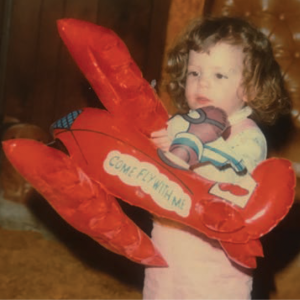
If it were simply based on outward appearance, some would compare her to a golden sunset. Once she makes eye contact with you, and flashes that mischievous, infectious smile, you become entranced. From her curly coiled sandy blonde hair to her dark piercing eyes, Britt could easily be mistaken for a New York fashion runway model. But the only runway this former Montana farm girl relies on is the one she rockets from in her Extra 330SCX.
But do not let those looks fool you. Once you dissect her life story, you quickly realize Britt Lincoln is more like a “once in a lifetime comet” — all the beauty and splendor lie within this shining aviation star.
Born and raised on a farm in North Central Montana, 12 miles south of the Canadian border, Britt grew up surrounded by wide open spaces, endless skies, and airplanes.
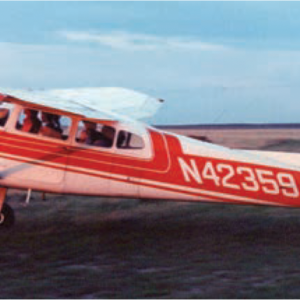
“The closest neighbors were 2 miles away,” Britt said. “My school was over 20 miles away, and there were 18 people in my graduating class. Because we lived in such a remote location, my grandfather would sometimes fly us to school in his Cessna 180 and land on the two-lane highway north of town. He would taxi into the parking lot right behind the school and drop us off. This was my ‘normal’ growing up.”
Aviation has been in Britt’s family for generations.
“I am a fourth-generation pilot on my father’s side, and my great-grandfather was the first person in our family to learn to fly,” she said. “After he got his pilot certificate, he began crop dusting in a J-3 Cub and taught his son, Roger, my grandfather, how to fly. Roger had his own airplane before he had a car. At one point in their lives, the two of them dusted together, primarily wheat and barley. The aviation DNA was passed onto me.”
Britt was 5 days old the first time she was in an airplane — a Cessna 180 that her grandfather had bought new from the factory. Britt is the current caretaker of it.
“During the summer, I was woken at 4 a.m. most mornings by the sound of the filling of spray plane hoppers and the roar of them taking off right in front of the house,” Britt said. “By age 12, my job was driving a tractor and becoming the designated combine driver during harvest. That tradition continued into adulthood even after I graduated from college and had a career.”
The work ethic infused in Britt by her grandparents, Mable and Roger, set her foundation in stone. Their family creed: “If you start something, you finish it. You don’t quit, ever.”
“Looking back, I realize how empowering that was,” Britt said. “It was always positive, confidence-building. Believing and supporting that I can do anything. I never heard, ‘Girls can’t do that,’ ‘You’re too young,’ or ‘You are not strong enough.’ None of that was ever spoken. It was only encouragement.”
Learning to fly did not come until later in life for Britt. She began learning to fly, taught informally by her grandfather, in the Cub in high school. But because she was so involved with extracurricular activities like sports and working on the farm, flying was never the priority. Despite the aviation-rich environment, she did not initially see flying as her future. Instead, she pursued degrees in accounting and German and spent more than 15 years in the finance world, including time overseas.
 Late Departure With a Rapid Climb
Britt repatriated to the United States in 2010, moving to the San Francisco Bay Area. She continued her work in accounting and finance and, of course, went home more frequently. It was not until 2017, after returning home, that she realized something was missing.
“My grandfather was getting older and decided to hang up his headsets and retire from crop dusting,” Britt said. “I knew that unless I got my pilot certificate, the time was approaching that I wouldn’t be able to fly with him anymore — a pastime that was so special to me and had created so many wonderful memories. I didn’t want creating new aviation memories together to come to an abrupt halt.”
That realization sparked a journey that would transform her life — and the world of aerobatics. Although Britt had flown all of her life, she never officially earned a pilot certificate. She began formal training in Concord, California, in a Cessna 172.
“It was the first time I had ever flown a nosewheel,” Britt said. “My instructor had never flown a tailwheel. He would get irritated with me and say, ‘What are you doing with your feet? Stop moving your feet so much! You don’t have to move the rudder pedals that much.’ I did not know any better. I was taxing a nosewheel like a Cub.”
Britt earned her private pilot certificate in November 2017. What began as a practical decision quickly evolved into a passion. Within a year, she had earned five certificates/ratings: instrument, commercial, multi-engine, seaplane, and commercial seaplane. She had found her calling.
Her introduction to aerobatics was serendipitous. One day, she passed a hangar with its doors open and spotted a Super Decathlon and a Pitts S-2B. Curious, she wandered inside. The owner offered her a ride in the Pitts. By the end of the flight — after loops, rolls, rolling turns, and lomcováks — he told her, “You need to learn how to do this.” She did. Within weeks, she was training in a Super Decathlon. After just five lessons, she entered her first aerobatic competition.
“Most people think aerobatics is all adrenaline, but it’s not,” Britt said. “It’s the exact opposite. It’s exploring the full envelope of the aircraft while learning to remain calm, controlled, and precise. It’s about mastering the aircraft and making the airplane do exactly what you tell it to do. It’s mastering energy and altitude management. It’s not just being a pilot — it’s being an aviator.”
Britt’s rise in the aerobatic world was meteoric. Since 2019, she has competed in over 20 competitions and won 17. In 2023, she made history by becoming the first woman in 30 years to win the U.S. Advanced National Aerobatic Championships. That same year, she represented the United States at the World Advanced Aerobatic Championships (WAAC) in Las Vegas, placing seventh overall — the highest score among U.S. pilots — and helping Team USA secure a bronze medal.
Her air show flying style is a blend of competition precision and air show artistry.
“Competition is about absolute precision — perfect vertical lines and brick-wall stops,” she said. “Air shows are about storytelling, emotion, and connection. In my air show routine, I pay homage to my competition roots while adding gyroscopic maneuvers and artistry.”
She performs high-energy routines that leave audiences breathless — tumbles, torque rolls, and knife-edge passes, all choreographed to music and smoke.
Fly Like a Girl – Continues In Next Weeks Issue of Scott County News.
Subscribe today! Call (423)-569-8351