Local Landfill fight goes to Nashville
PROTECTED CONTENT
If you’re a current subscriber, log in below. If you would like to subscribe, please click the subscribe tab above.
Username and Password Help
Please enter your email and we will send you a password reset link.
Local Landfill fight goes to Nashville

Cumberland Clear President
Jennifer Shockley

Ralph Trieschmann
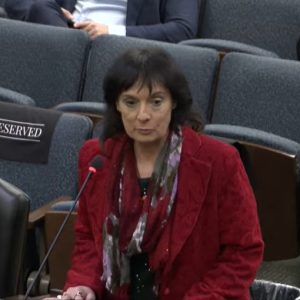
Darlene Price
By Shane Gilreath
SCN Contributing Editor
[email protected]
Members of Cumberland Clear, the citizen-based organization that formed in response to the Roberta II landfill controversy, traveled to Nashville last week to address the Tennessee Solid Waste Task Force, raising concerns about the contentious landfill proposal that have plagued Scott County for much of the year.
Established this year, the Tennessee Solid Waste Task Force was assembled to explore the state’s proposed waste industry crisis and charged with finding solutions for disposal, recycling, and environmental protections, a contentious issue that Cumberland Clear did not let slide. While much of the meeting focused on statewide strategies, Cumberland Clear representatives were quick to use the opportunity to highlight local opposition to Roberta II and the Rail-to-Truck transfer station contrived for North Oneida and Winfield.
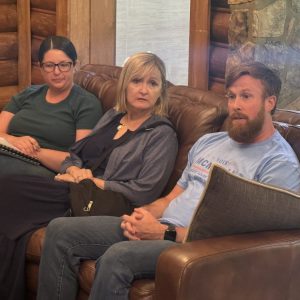
Cumberland Clear President Jennifer Shockley, Ralph and Michelle Trieschmann, and Darlene Price, a McCreary County, Kentucky, native and host of the podcast Truth or Politics, traveled to the state capital to plead Scott and McCreary County’s case with an opportunity to address the task force directly.
Ralph Trieschmann, who, alongside his wife, Michelle, is the proprietor of Timber Rock Lodge, was quick to remind the legislators and assembled waste experts that environmental impacts do not respect county lines, stating an obvious truth around the ultimate path of the Cumberland River. What enters the Big South Fork of the Cumberland River, he noted, ultimately flows into Nashville through the Cumberland River system.
“We are here to defend our home and business,” Trieschmann said, saying that he spoke as a local business owner and with the authority of his roles as a director with the Scott County Chamber of Commerce and Chair of the Oneida Industrial Development Board, both who have opposed the project. “Our community is under attack – again,” he emphasized, “by speculators who think that rural Tennessee is an easy target.”
Trieschmann’s argument was not unlike many recent opponents who have long cited a lack of need for Roberta. It was an argument established, via a letter, by the Scott Solid Waste board (SCSWB) earlier this year. Alongside the SCSWB, Trieschmann listed numerous leaders, government agencies, and organizations who have publicly opposed the project. “This is not the hysteria of so-called ‘ignorant citizens groups,’” he told members. “These are informed voters, elected leaders, scientists, and business owners.”
Shockley, in turn, echoed those concerns, warning that out-of-state dumping operations often extract profit from Tennessee while leaving long-term damage behind for the state’s citizens to deal with in the aftermath. “What we keep seeing across Tennessee is that extracting industries and dumping operations show up from out of state with a polished pitch, but the reality is always the same,” Shockley said. “They make a great deal of money and then they leave and take that money with them. It does not stick around in our state. Instead, they leave behind the damage.”
In what has become a disputed stance, Shockley challenged the board on the assertion of the state’s landfill crisis, asking, “if the state has such a crisis, why are we continuing to allow this type of out-of-state operation to bring waste into Tennessee?” It was a question that, by design, went unanswered. “Landfills are a dead end,” Shockley told the board.
Price, a longtime environmental advocate and author of “While No One’s Watching,” cautioned that Tennessee risks following Kentucky’s path. “We have the highest cancer rate in the nation,” she testified, citing PFAS and asbestos concerns which plague the Roberta proposal. In a sharp statement that cut through the issue, Price added, “The UK Wildcats like competing against the Vols, but you don’t want to be competing with us for that.”