Cumberland Clear looks at litigation, politics in effort to stop Roberta
PROTECTED CONTENT
If you’re a current subscriber, log in below. If you would like to subscribe, please click the subscribe tab above.
Username and Password Help
Please enter your email and we will send you a password reset link.
Cumberland Clear looks at litigation, politics in effort to stop Roberta

By Shane Gilreath
[email protected]
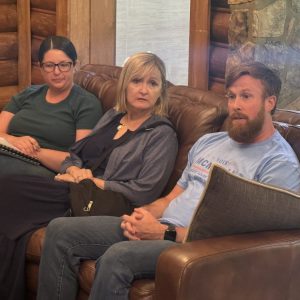
In a meeting that ran late on Tuesday, Cumberland Clear, again, tackled the seriousness of the proposed landfill and transfer station in North Oneida in what was their first public meeting in a matter of weeks. The organization, which has sought to educate Scott and McCreary Counties on the dangers of the landfill proposal, had clearly been working diligently behind the scenes, following what organizers deemed a disappointing public meeting with TDEC earlier in the month.
“At the TDEC meeting, they had promised they’d talk about the transfer station and Roberta II, but they reversed course,” said Cumberland Clear President, Kathy Obrusanszki, suggesting what may have caused TDEC’s change was a meeting between Cumberland Clear’s lawyer, Elizabeth Murphy, Lisa Helton, the lawyer for the Scott-McCreary Environmental Coalition (SMEC), and the lawyers for TDEC.
“TDEC realized that we will do whatever it takes,” said Obrusanszki. “Cumberland Clear will be suing.”
The revelation that lawsuits were forthcoming – seemingly soon, if the direction of Roberta does not cease – was surprising news to many in attendance, despite a similar announcement from Cumberland Clear’s Ralph Trieschmann last week at the SMEC meeting in Oneida.
“It’s getting real,” Obrusanszki said. “It will be going to court.”
As litigation moves forward, Obrusanszki stressed the importance of fundraising awareness as a means to prolong the fight. “We have got to be able to pay our lawyers,” she said, but another recent development of concern for the organization is Roberta II’s Aquatic Resource Alteration Permit (ARAP) application, which, as previously reported by SCN, was filed one day after TDEC came to Scott County.
An ARAP is required in Tennessee for any project that alters a stream, wetlands, and waterways, and remains the state’s effort to regulate invasive activities like dredging, construction, or landfill operations that could directly impact water quality. Environmental advocates have long warned that projects approved under an ARAP could introduce pollutants or sediment into waterways, increase flood risk, and threaten the local watershed. In the case of Roberta II, Jennifer Shockley noted, “It’s a significant amount of water on this property. There are streams that go straight to our watershed.”
Nancy Stringer, who’s been a frequent face at Cumberland Clear events, was quick to point out a seeming inequality and why an area, like Scott County, would be chosen. “We’re among the poorest counties in Tennessee,” Stringer said. Darlene Price, a McCreary County lawyer who hosts the online news program, Truth or Politics, was quick to respond. “That’s why they came here,” Price said.
Price’s stance may well be supported by data. As previously addressed by SCN, research shows that poor communities in Appalachia are disproportionately targeted by waste management facilities. Studies from the Appalachian Regional Commission and environmental justice researchers indicate that counties with lower median incomes, higher poverty rates, and less political clout are often chosen to host landfills and transfer stations at higher rates than wealthier areas. Scott and McCreary Counties are no exception. They are regularly included in lists of the most distressed counties in their respective states.
The idea of political clout was a particular interest to Price, a former US Senate candidate in Kentucky, who has been a vocal opponent of Roberta II, both on her program and at public forums. Price spoke openly about the political pressure that elected representatives should be feeling from citizens, especially with election season rising. That included, for Price, term-limited governor Bill Lee, who she suggested could stop Roberta II with a phone call to TDEC. If he doesn’t, Price said, “we should call it ‘the Bill Lee Dump pile.’”
Lee’s days, however, are numbered. Currently campaigning to replace him are a slew of candidates in both parties, including 6th District Congressman John Rose, who represents Scott County, and U.S. Senator Marsha Blackburn, who has consistently led polls. While there are no immediate ties to Rose or Blackburn and the waste management industry, according to sources, Blackburn has consistently received contributions from waste management PACs and employees throughout her political career.
“We need to focus on Governor Bill Lee,’ Price said.