Donors could be key to Cumberland Clear’s landfill battle
PROTECTED CONTENT
If you’re a current subscriber, log in below. If you would like to subscribe, please click the subscribe tab above.
Username and Password Help
Please enter your email and we will send you a password reset link.
Donors could be key to Cumberland Clear’s landfill battle
Organizers Wrangle with Jeffers over records
By Shane Gilreath
Photos by Shane Gilreath
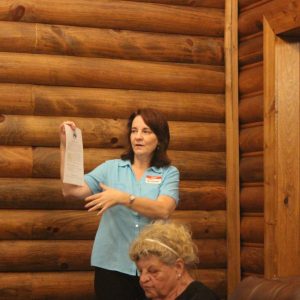
Kathy Obrusanszki, President of Cumberland Clear, addressed the organization’s meeting on Monday, August 4, 2025. Obrusanszki and other organizers continue to express the importance of fundraising in their fight against environmental degradation across the Cumberland Plateau, including the proposed second landfill in Scott County.
An August 3rd meeting of Cumberland Clear began to outline the organization’s plans to combat the proposed second Scott County landfill and other environmental concerns across the Cumberland Plateau. “We have a top notch lawyer,” said Kathy Obrusanszki, the organization’s president and a leading opponent of the landfill. That lawyer, Obrusanszki informed followers, was expensive, making fundraising from the public vital to the organization’s success. According to Treasurer Alison Cowen, “Cumberland Clear has established its first fundraising goal of $5,000, which will help fund legal expenses, community awareness campaigns, and public outreach/advocacy.” Cowen tells SCN that the organization has created several means to support their effort. Ways to donate, according to Cowen, include the use of a credit card or bank account by visiting www.cumberlandclear.org and clicking “donate.” Otherwise, supporters can donate by US mail, via checks made payable to “Cumberland Clear” to PO Box 4751 Oneida, TN 37841. Organizers, Obrusanszki said, would also be willing to arrange a meeting for cash donation. Organizers can be reached by email at [email protected].
“Every dollar matters, large or small, and will enable us to take the necessary steps to protect our community,” Cowen told SCN.
Outside of litigation costs, the organization plans to take independent soil and water samples, after alleging conflicts in the prior samples. “The person who did the samples for TDEC – Dr. Hyfantis – worked for Horner’s company up until 2 years ago,” Obrusanszki said, referring to Knox Horner, who has been the public face of the second landfill, and Dr. George Hyfantis. SCN can confirm that Hyfantis, who has a 40 year history in the waste field, has been named (or copied) on several communications obtained by SCN, including communications naming Horner, Roberta Landfill, the recertification of Roberta Landfill Phase II, the existing landfill permit, and a 2020 bankruptcy case from Unison Environmental Services, LLC, in which Horner is named as the principal debtor and Hyfantis as a retainer of the debtor, suggesting the potential for a conflict of interest under Tennessee law.
Hyfantis, however, has a long, respected history in the industry, serving as the governor’s appointee to the Underground Storage Tanks and Solid Waste Disposal Control Board, who is responsible for protecting human health and the environment by preventing future petroleum underground storage tank releases and remediating existing contamination. With the TDEC recertification of the existing permit hanging in the balance -on which Hyfantis and Horner appear in varying capacities – the organization continues to seek visibility and awareness across the area.
“We support businesses that come to our town and long term plans, but the landfill is not one of those,” said Ralph Trieschmann, a vocal opponent of the landfill development.
To make that happen and to create more awareness, the organizations looks to do fundraisers and public hearings across Scott and McCreary Counties. Cowen told SCN that if interested parties are unable to make monetary donations, volunteer opportunities are available and needed. “Together,” she said, “we can protect what matters most!”
The following day, SCN received a press release from the organization over Open Record Requests sent to county government, saying Cumberland Clear had submitted multiple requests for records to the County Mayor Jerried Jeffers, seeking all communication records regarding the proposed landfill.
The first request, according to the press release, sought minutes of the most recent Scott County Solid Waste Board in March 2025, when Knox Horner, among others, was present. According to the statement, in addition to minutes, Cumberland Clear’s Jennifer Shockley requested a copy of its most recent 10-year plan for waste management.
A second request was sent from the organization seeking minutes from the Solid Waste Board from 2004 to 2010, any resolutions from Solid Waste Board during the subsequent time frame, as well as any documents that reference or consider the permit for the current landfill proposal.
To date, the statement read, the only documents provided were minutes from two meetings held in 2005 and minutes from the meeting held in March of this year. In a recent follow-up conversation with Cumberland Clear, Mayor Jeffers is alleged to have informed representatives of the organization that no other records exist, citing their destruction by “a prior administration.”
“We believe the public has a right to full transparency—especially when decisions could affect the health, environment, and economy of Scott County for generations,” read a statement from Obrusanski. “We’re not asking for anything extraordinary—just basic public records, which should be retained and made accessible under Tennessee’s public records laws.”
The statement requested that county government uphold its commitment to open governance and provide the public, in this case Cumberland Clear, with all available information regarding the controversial landfill proposal.
SCN, in turn, reached out to Jeffers for comment. “We have supplied all the information that we have,” Jeffers told SCN. “Not only myself, but CTAS and the County Attorney. We have supplied what we have available.”
Jeffers told SCN that his office has been forthcoming with information and is consistent with providing data via the Freedom of Information Act, with each petitioner filling out a form. “If I make one person do it that way, then the next person has to do it that way,” Jeffers said.
(While Solid Waste Board minutes are often treated similarly to other governing-body records and designated as permanent records, Tennessee law requires only that solid waste records—such as those tied to a landfill’s planning cycle—be kept for 10 years, but this applies only if a local government operates a landfill, and does not apply directly to board meeting minutes. However, a 10-year plan applies to all municipal solid waste regions (which can be a single county or a multi-county region) because the plan is meant to ensure there’s enough disposal capacity and waste-reduction strategy for the next decade.)