
Mike Marlar 30 years of Winning
PROTECTED CONTENT
If you’re a current subscriber, log in below. If you would like to subscribe, please click the subscribe tab above.
Username and Password Help
Please enter your email and we will send you a password reset link.
Mike Marlar 30 years of
Winning
By Chris Tilley
Part 1
It was a sweltering hot August day in 1994 when a shaggy-haired teenager from Scott County, Tenn. strapped into a race car for the first time. After spending a lot of his childhood in the bleachers watching his idols, including his father race, an aspiring second-generation racer wanted to take a shot at racing.
The perfect storm was developing right before Mike Marlar’s eyes and he didn’t even know it.
Accompanying Marlar in the building of his first race car was childhood friend, distant cousin and neighbor Derrick Strunk. The duo worked all summer to put together what they thought would be a winning car. With help from Billy Todd building the powerplant for the race car, the reality of winning his first race was almost in Marlar’s grasp. Thanks to race promoter Billy Teegarden, the track, on his first race, was slow and slick and as Marlar called it an “ice skating rink”. The track surface would set Marlar up for success in his first night out.
Little did Marlar know, the first “Road Hog” win coming on August 13, 1994 at Lake Cumberland Raceway just outside of Burnside, Ky. would be the first of many to come.
The night Marlar won his first feature event at the local track was the same night Dale Atwood, longtime Marlar idol, was claiming victories in the Late Model and Bomber divisions. Mike’s father, David, also competed at the track located just forty minutes north of their hometown of Winfield, Tenn. The elder Marlar then competed in the Bomber division and on Mike’s second night out two weeks later, he ran seventh in the Road Hog Feature while his father took the checkered flag in the Bomber feature.
Marlar credited Atwood, Joey Daniel and Tom Curtsinger as racers he looked up to. “I studied those guys, they were winning at the local race tracks and not tearing up stuff, I wanted to be like those guys.” Following in his father’s footsteps to winning on the national stage was only a dream in the sixteen-year-old’s mind before that night. “I have to give Billy (Teegarden) credit too. “He gave me some really good advice early on in my career, he was a really good guy and wanted to keep local racing affordable. He kept the race track smooth and the rules package kept the racing good back in the day where guys on a budget could win.”
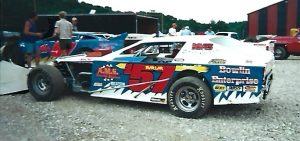
After the progression from the Road Hog to one season in the Bomber division, Marlar took a stint driving the Open Wheel Modifieds. With drivers competing for UMP (United Midwestern Promoters) national and regional points, most tracks within his region ran the governed rules where drivers could race and accumulate points plus racing against some of the best in the nation didn’t hurt polishing Marlar’s skills.
Marlar and friend Jimmy Owens, a four-time National Champion, chased Bob Memmer’s UMP points weekly in 2002 traveling all across UMP country in search of that elusive title and the $100,000 that went with it. Not only was Marlar’s points chasing honing his skills for the future, the group of drivers from this area including Victor Lee, two-time UMP National Champion Danny Yanders and many more were putting on some of the greatest shows for the race fans in the region.
“We went to Bardstown, Ky. (Bluegrass Speedway) for a big Modified race one night. They had over 80 Modifieds there. I didn’t even make the show. There were a few 57-numbered cars there. I knew I had to change the car number. So, I went with the # 157 after that,” said Marlar. “I wanted to know where I would be in the lineup and make sure we didn’t get left off the lineup,” Marlar said laughingly.
“Points racing was different back in the day. When we were chasing UMP Modified points, if an event rained out close to you, you had a lot of options to catch another race within a few hours and still run the same type of car and be able to still get points,” stated Marlar. “Points racing is a lot different now. When you have to travel 5-700 miles to a race and it rains out, you kind of lose the wind out of your sails,” said Marlar again.
Open Wheel Modified drivers have been overheard saying throughout the years that the modifieds are harder to drive than the dirt Late Models. The transition from the Modifieds seemed flawless for Marlar as he was slowly solidifying his place early on in such a competitive sport.
In 2003, Marlar went Late Model racing with the STARS Battle of the Bluegrass DirtCar Series. In route to his series championship and rookie of the year title, Marlar claimed five victories along the way coming at Richmond (Ky.) Raceway twice, Mountain Motor Speedway (Isom, Ky.), Scenic Raceway in Marlar’s hometown and Ponderosa Speedway (Junction City, Ky.). Marlar had a 500-point win advantage for the series title over Timmy Yeager, Aaron Hatton, Jesse Lay and Scott James. “In 2003, we wanted to build a team and get our feet under us.” With the help of Wayne Bowen and legendary racer and chassis builder C.J. Rayburn, Marlar’s plans for having the equipment and trailer to travel up and down the road racing regionally became a reality.
In addition to the Battle of the Bluegrass accolades in 2003, Marlar won a Northern Allstars Late Model Series event in Burnside, Ky. as well as the prestigious Kentucky Klassic at Barren County Speedway in Glasgow, Ky. Ironically, the first major event win in a dirt late model came the same night the writer of this story promoted his first-ever race.
Marlar’s winning ways continued during the 2004 campaign as he claimed payday in Carl Short’s Hillbilly 100 at Tyler County Speedway in Middlebourne, W.V. That win was worth $25,000 as he drove a C.J. Rayburn Race Car, one of only three Rayburn manufactured race cars in the field at Tyler County. The engine in the car was a steel-block, which had a lot less power than the open competition engines most drivers had. Rayburn knew that the steel block engine would have a weight advantage on the field. “At some point in the feature event while leading, I hit a piece of lead on the race track and in victory lane, the front straightaway was flooded with oil. The lead had gone through the oil pan and the only thing keeping oil was the vacuum of the engine,” stated Marlar on his first crown jewel event win.
In prepping for the Hillbilly 100, Marlar made the trip south to Atomic Speedway located just outside of Oak Ridge, Tenn. for a World of Outlaws Late Model Series race and ran seventh in the main event. Marlar knew that Atomic wasn’t the best “Rayburn” race track but could help him in events to come. That top-ten finish propelled him into victory lane just a few nights later in the Mountaineer State. Marlar went on to win the Hillbilly 100 again in 2012, this time at another West Virginia oval, I-77 Speedway.
2004 was a breakout year for Marlar. A $20,004 victory at Magnolia Motor Speedway in Columbus, Miss. the first weekend of October was setting up Marlar to end the season with huge success. Two weeks later at Bluegrass Speedway for the Dirt Track World Championship, Marlar would win his heat race of the 93-car field on hand and now be in contention to win the $60,000 prize put up by race promoters Carl Short and David Ferrell.
In what became known as the ‘oil gate conspiracy’ at Bluegrass Speedway, Marlar remembered, “I was a prime candidate to win that deal, it (the track) had rubbered and some of the drivers were mad because the track rubbered and I was on the pole. That’s when they (other competitors) all poured oil on the track and we all went in there and crashed on the start.” Marlar finished 23rd in the main event after destroying a race car during that melee. “I was just driving around the racetrack and saw that the track looked wet but most of the time before the feature, everybody fills their gas tanks up and the extra fuel comes out of the overflow and falls out on the track a little bit. It’s not really slick when you hit it, it’ll dry up about as fast as it hits the ground, so we’re going around the track. I saw liquid on the track but I thought it was overflow from somebody’s gas tank. What I didn’t know, a bunch of drivers took quarts of oil and poured them out of their cars out on the racetrack so I went down in turn one leading this thing and destroyed the car,” Marlar recalled. “They definitely altered the event.”
Mike Marlar – Thirty Years of Winning will continue in next weeks edition, September 12, 2024.
Chris Tilley Photo
Mike Marlar in 1999 in Dirt Modified