County Hears from Candidates
PROTECTED CONTENT
If you’re a current subscriber, log in below. If you would like to subscribe, please click the subscribe tab above.
Username and Password Help
Please enter your email and we will send you a password reset link.
County Hears from Candidates
Photos by Shane Gilreath
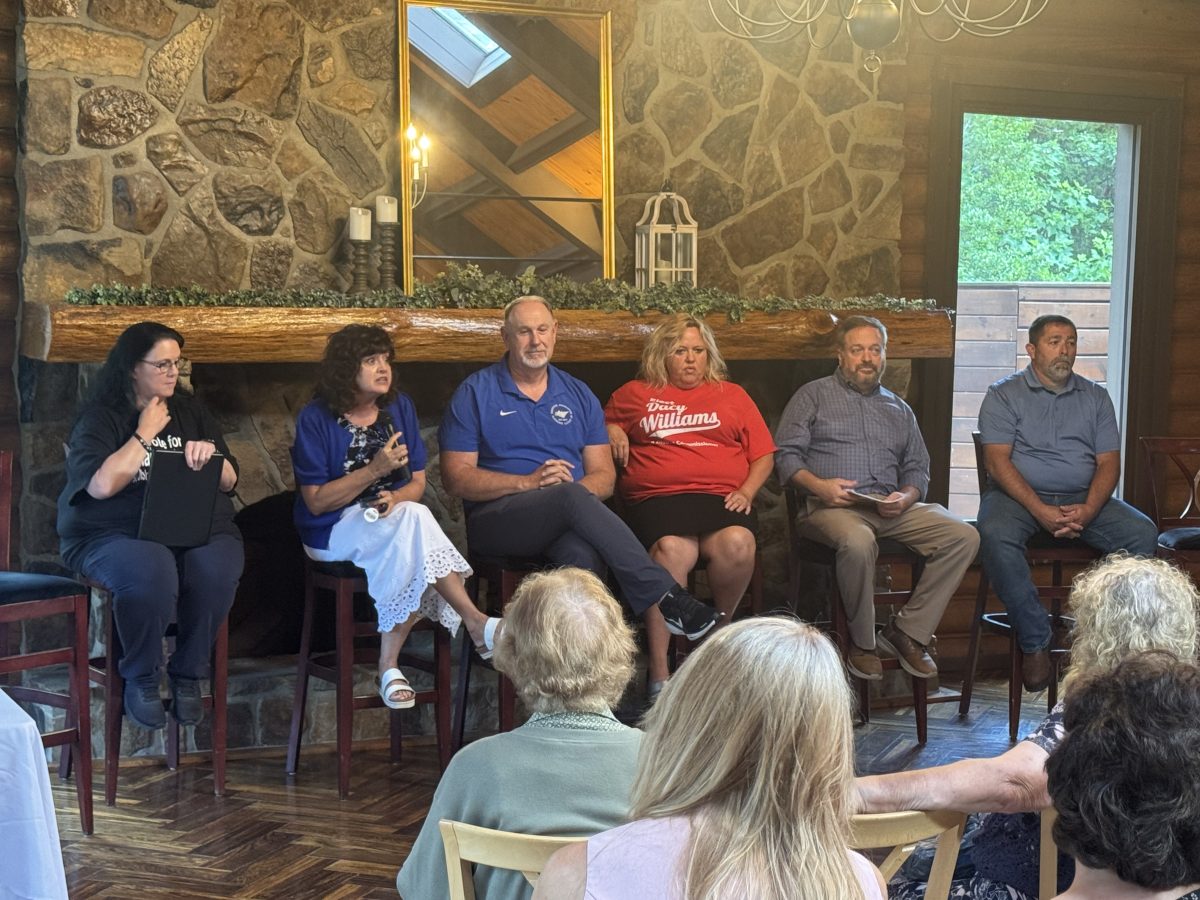
Five candidates for Scott County Commission answered questions during Thursday’s Candidate forum at Timber Rock Lodge: Elaine Lowe (Dist. 1), Joyce Keeton (incumbent, Dist. 2), Mike Keeton (Dist. 3), Dacy Williams (Dist. 3), Ralph Trieschmann (Dist. 2), and Jason Perry (Dist. 6).
By Shane Gilreath
SCN Contributing Editor
[email protected]
The 2026 Scott County Candidate Forum gave local voters an opportunity to hear directly from candidates seeking county and state offices, with discussions ranging from school funding and economic development to government transparency and the proposed Roberta II landfill. Although several invited candidates declined to participate, did not respond to invitations, or were unable to attend because of prior commitments, those who took the stage spent nearly three hours answering questions on issues affecting Scott County’s future.
The evening opened with county constitutional offices. Incumbent Trustee Rene Erwin told attendees that her priority has been protecting taxpayers’ money by seeking the best possible return on county investments while maintaining sound fiscal stewardship. In the County Clerk’s race, Felicia Bilbrey, the only candidate to attend the forum, pointed to her years of experience serving the public.
“Serving has been one of my biggest honors,” Bilbrey, who serves as the 2nd Vice President of the Tennessee County Clerk’s Association and touted her years of experience, told those in attendance.
The first full panel of the night featured candidates seeking seats on local Boards of Education. The candidates largely agreed that the districts had managed their finances responsibly while acknowledging challenges facing public education across Tennessee.
“I think our district has done a good job budgeting,” Stuart Jones, a candidate for Oneida Special School District, said, with fellow candidate Kevin Byrd, also a candidate in Oneida, echoing that assessment. Byrd argued that a successful school system begins with investing in the people who make education possible.
“Budgetarily speaking, a strong school is the result of a strong staff,” Byrd said.
Scott County, District 5 candidate Roger Douglas agreed that the district has remained financially responsible, but stressed that every dollar should be carefully spent and that each school within the county deserves equal consideration when improvements are made and monies are dispersed. Matt Stiltner (Scott County, District 7) pointed to a broader concern, noting that Tennessee continues to rank near the bottom nationally in per-pupil funding.
“That’s unacceptable,” Stiltner said.
Enrollment also became a recurring topic. Jones praised the creation of the Oneida district’s virtual academy, saying the program should help retain students who might otherwise leave the public school system. Since the COVID-19 pandemic, Tennessee has experienced significant growth in homeschooling and alternative education programs, forcing many districts to compete for enrollment.
“The look of public schools is drastically changing,” Jones acknowledged.
Byrd added that a positive school culture is one of the best ways to encourage families to remain in the district, while Douglas, who serves as a school resource officer in Campbell County, said student safety remains his highest priority. Stiltner advocated for Blue Dot Awareness, a statewide initiative intended to help law enforcement better recognize and assist individuals with autism and other developmental disabilities during emergency encounters.
County Commission candidates then took the stage, where moderator Delilah Wright guided discussion through several of the county’s most contrreoversial issues. Unsurprisingly, the proposed Roberta II landfill dominated much of the conversation and did so throughout the event.
“As a teacher, it’s something I’m passionately against,” Joyce Keeton, an incumbent commissioner in Distrct 2, said. “We’ve had two Scott County students with cancer. Those are my kids.” Keeton argued that the landfill would bring few long-term jobs while creating unnecessary health and environmental concerns for surrounding communities.
Elaine Lowe, a candidate in District 2, drew laughter from the audience after criticizing efforts to market the landfill project as an “Ecology Park,” a recent development seeking to gain public, financial, and government support for the Roberta II proposal.
“You can take a cow and paint it,” she said, “but it’s still a cow.”
Mike Keeton, candidate in District 3, shared stories from individuals he knew who had responded to landfill sites elsewhere in Scott County and later suffered significant health problems, while several candidates emphasized that economic development should not come at the expense of public health.
The discussion soon expanded beyond the landfill to the county’s overall economic future. Dacy Williams (District 3) called for attracting sustainable industries that would provide stable employment opportunities, while Ralph Trieschmann (District 5) argued that Scott County must actively pursue growth instead of waiting for it to arrive.
“In business school, we’re taught to grow or die,” Trieschmann said. “I’m running to be part of the planning.”
Jason Perry agreed that the county needs responsible growth, observing that Scott County has changed considerably over the years and must prepare accordingly. From that discussion, tourism emerged as a major topic. While candidates differed on how aggressively Scott County should pursue development, nearly all agreed that the county’s natural beauty remains one of its greatest assets.
“We need to grow,” Lowe said. “But we want to keep our country life.”
Joyce Keeton expressed support for both industrial recruitment and tourism initiatives, while Williams cautioned that tourism can bring unintended consequences if growth is left unchecked.
“I would move away if I lived in Pigeon Forge,” Williams remarked.
Trieschmann pointed to the economic impact of visitors to Big South Fork National River and Recreation Area, noting that tourist spending provides valuable tax relief for local residents. Perry likewise said tourism offered considerable opportunity if managed responsibly.
Candidates also spent considerable time discussing transparency in county government, an issue that has remained in the spotlight since debate over the Roberta II landfill began more than a year ago.
“Transparency is important,” Joyce Keeton said, adding that special-called meetings should be better publicized.
Mike Keeton agreed, further saying that elected officials should provide direct answers to citizens’ questions instead of what he described as “word salad.” Williams called for greater transparency in the county budget, while Trieschmann reminded voters that elected officials ultimately answer to taxpayers.
“Elected officials work for us,” he said.
Perry concluded by saying he believes in “100% transparency” and pledged to continue asking difficult questions if elected.
Scott County Sheriff’s candidate Kris Lewallen, who currently works in Drug Enforcement in Fentress County, was the only candidate seeking that office to attend the forum. Lewallen said he would aggressively pursue additional grant funding for the department – something mayoral candidate Jennifer (Terry) Shockley would later agree with – while emphasizing professionalism, accountability, and respect for every citizen.
“The sheriff’s office is here to serve the people,” Lewallen said, adding that morale begins with leadership and that his administration would provide regular reports to keep the public informed.
Only one candidate seeking the office of Scott County Mayor appeared before voters. Jennifer Shockley centered much of her presentation on economic and job development, strategic planning, and the county’s response to industry, first responders, and the proposed second landfill.
Shockley, who currently serves as president of Cumberland Clear and has been a vocal opponent of Roberta II both at home and in Nashville, said Scott County has failed to position itself to compete successfully for many state grant opportunities despite having access to I-75 and a major rail corridor.
“We have to have a plan to get better jobs,” she said. “We know we need better industries.”
To accomplish that goal and relieve some financial burden and offset costs to schools and first responders, Shockley proposed hiring a dedicated grant writer to pursue additional funding for county government, schools, and law enforcement. Reflecting on the past year of opposition to Roberta II, she said local officials cannot rely solely on state government to protect Scott County from unwanted development.
“The state assumes that if we care, we already have tools in place,” Shockley said to one of the evening’s loudest rounds of applause.
She also pledged to prioritize first responders in future county budgets, arguing that emergency personnel deserve greater financial support if they are expected to protect local communities effectively.
“I feel like I have stepped through doors because no one else would step through them,” Shockley said, of the experience she has gained while fighting for Scott County in her work against Roberta II.
The evening concluded with candidates for state office, including Democratic House candidate Seth McMillian and Independent gubernatorial candidates Charles Van Morgan and Dave Seeman.
Housing emerged as the first topic, with McMillian arguing that expanding housing opportunities is essential if Scott County hopes to attract employers and strengthen its workforce.
“We lack housing,” McMillian said. “I see that as foundational.”
Discussion soon shifted to health care, energy, and economic development. Both McMillan and Seeman advocated expanding access to health care while Morgan argued that political corruption remains the state’s greatest obstacle to prosperity.
“Politics is civilized warfare,” Morgan said. “If you stop the corruption, you’ll have a better economy.”
As expected, Roberta II again became a central issue before the evening ended. McMillian said major projects affecting local communities should not move forward without public knowledge and support, while Seeman voiced support for preserving Jackson Law protections. Morgan argued that local residents ultimately should decide such matters through the officials they elect.
No matter their positions, most candidates framed the coming election as an opportunity for voters to determine what Scott County and the state will look like in the years ahead. The evening concluded with fireworks, as Charles Van Morgan angrily clashed with the audience (see story A1).
Candidates who have not recieved information on SCN’s Special Election Isssue on July 30, 2026, should contact SCN today. All candidates are welcome to participate.