A Derailment Next Door Could Be a Warning
PROTECTED CONTENT
If you’re a current subscriber, log in below. If you would like to subscribe, please click the subscribe tab above.
Username and Password Help
Please enter your email and we will send you a password reset link.
A Derailment Next Door Could Be a Warning
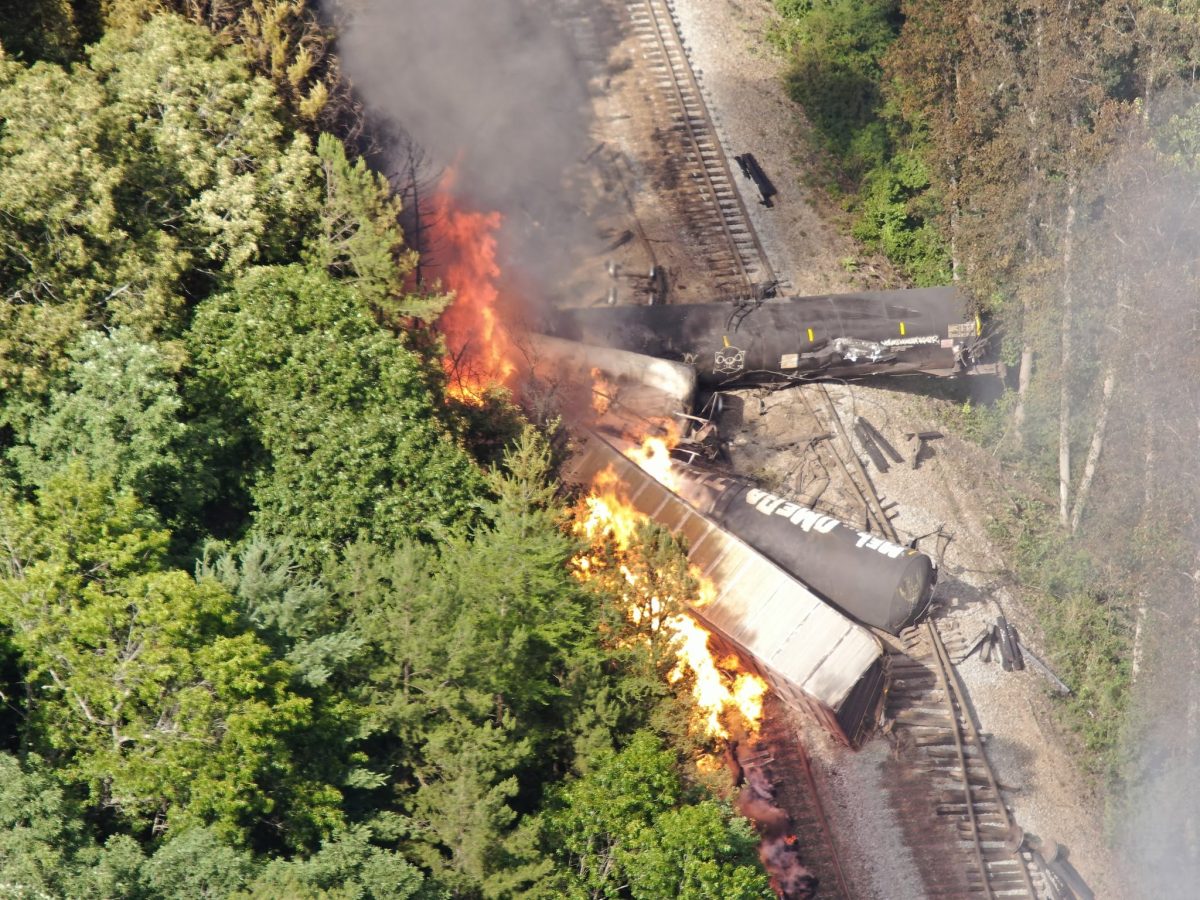
Photo by Blue Line Security, Inc.
A Morgan County train derailment not only made national news and closed parts of the National Park, but reminded locals of the possibilities that loom around the proposed Trans-Rail Transfer Station in Winfield, which would deliver waste to Roberta II.
By Shane Gilreath
SCN Contributing Editor
[email protected]
For more than a year, local opponents of the Roberta II landfill proposal have warned that the project carries significant risks extending far beyond the landfill itself. That concern has even drawn Scott County’s outgoing Director of Schools Bill Hall into the fight. On Thursday, just one county away, residents of Morgan County received an unwelcome reminder that railway transportation can become an emergency in an instant – just what Scott County has feared, as a train carrying ethanol left the tracks and ignited a fire that prompted evacuations, drawing the attention of both the Environmental Protection Agency (EPA) and the Tennessee Department of Environment and Conservation (TDEC).
While details remain sketchy as of press, early reports have indicated that multiple ethanol tank cars were involved, with several remaining on fire for an extended period – even into the early weekend – as emergency crews worked to contain the scene and monitor environmental conditions. While there are no reports of fatalities, officials have emphasized that environmental monitoring will be ongoing, a sobering glimpse into the kinds of consequences that can accompany rail transportation when something goes drastically wrong.
In Morgan County, it’s ethanol, but what could Scott County be? Ethanol is bad enough, and it’s not even among the most toxic substances transported by rail. When released in large quantities, ethanol presents risks of fire, explosion, air-quality impacts, and contamination of nearby waterways. Environmental agencies almost always become involved, SCN has learned, not merely because of what has happened, but because of what could happen in the future. In such scenarios, the EPA’s role is to monitor and assess potential impacts to air, water, and soil, while state environmental regulators, like TDEC, evaluate whether additional remediation and monitoring are necessary.
TDEC’s presence at the Morgan County derailment is no surprise. Despite some criticisms around the Roberta II project, the agency is responsible for protecting Tennessee’s natural resources and public health when industrial accidents happen. That responsibility becomes particularly relevant for Scott County because TDEC also holds a significant role in determining the future of Roberta II, a project that opponents argue will also put both the environment and public health at risk.
While a trash train is not an ethanol train, the incident in Morgan County highlights one of the more controversial aspects of the landfill proposal – its rail component. Critics across Scott and McCreary Counties have long argued that the project would not merely be another local landfill but a large waste network capable of bringing materials from across the country. Those concerns have focused on traffic, air, odors, decreased property values, environmental and quality of life issues, as well as public health and threats to pilots crossing the Scott County skies. The Morgan County derailment adds another question to the discussion: what happens when a train carrying waste or waste-related materials leaves the tracks?
Roberta proponents may argue that derailments are rare and that rail remains one of the safest methods of freight transportation. Statistically, they would be correct, but rarity has offered few comforts to the communities that find themselves in the path of an accident should one occur, especially as Trans-Rail Waste, the company that has proposed the transfer project, has recently touted approval from Norfolk Southern Railway’s Operating Department, dated Nov. 11, 2025 and the company’s Transportation Department on Dec. 16, 2025.
That proposed transfer station has generated particular concern among residents because of its proximity to both residential areas and Winfield Elementary. The image of emergency evacuations unfolding in Morgan County naturally raises questions about how a similar incident might affect nearby neighborhoods, schools, and businesses if a derailment were to ever to occur along a route serving Roberta II.
Derailments, though rare, do not inquire about cargo before they occur and a rail accident hauling waste could create unique challenges of its own. The concern becomes even greater when considering specialized waste that modern landfills sometimes accept, an accusation long waged at Roberta II. Coal ash, for example. While regulations govern its handling, coal ash can contain concentrated levels of arsenic, mercury, lead, selenium, and other toxic metals. A derailment involving railcars carrying such material near a river, creek, or drinking-water source could create environmental and public-health concerns extending far beyond an accident scene.
“If you live anywhere near the railroad, that’s now a dump. It doesn’t have to be tarped. There are no regulations for transfer stations and it’s a football field away from Winfield Elementary,” Cumberland Clear’s Kathy Obrusanszki said last August. “It’s in the dirt (students) are playing in.”
“How can we say we’re protecting children if we let this develop in their backyard?” Hall asked TDEC last November. The Director of Schools first appeared at a Winfield Mayor and Aldermen meeting in June 2025, when both TDEC’s Nick Lytle and Knox Horner, the public face of Roberta II, were in attendance.
“Children are more vulnerable to environmental toxins than adults,” Hall said. “Progress should never come at the expense of a child’s health.”
Hall’s assessment is backed by studies from such reputable institutions as Oxford and the National Institute of Environmental Health Sciences. Simply put, children are more vulnerable to environmental toxins because their bodies and organs are still developing, they breathe more air, eat more food, and drink more water per pound than adults, and their behaviors, indicative of childhood, like playing on the ground or putting objects in their mouths, increase exposure to harmful chemicals and environmental pollutants.
“Our children in Scott County already live in a place of hardship, a distressed community, where the odds are immediately stacked against them. And now this proposal threatens to push them even further down,” Hall said. “As if their challenges weren’t heavy enough, they deserve opportunities, not additional obstacles. They deserve clean air, safe spaces, and the chance to rise above what they were born in.”
Imploring TDEC to kill the Roberta project definitively, “I beg you,” Hall said. “Please help us protect what truly matter, our children.”
As TDEC continues to weigh Roberta’s ARAP appeal and litigation from Rock Properties sits in Nashville courts, each hold a decision that could shape Scott County for generations. For residents who have spent months asking questions about and fighting against Roberta II, the sight of railcars burning just one county away hits too close to home. The lesson from Morgan County is not that every train is dangerous. Rail transportation remains one of the safest and most efficient methods of moving freight. The lesson is that when communities and agencies evaluate projects dependent upon rail, like Roberta, they must also evaluate the consequences should something go wrong.